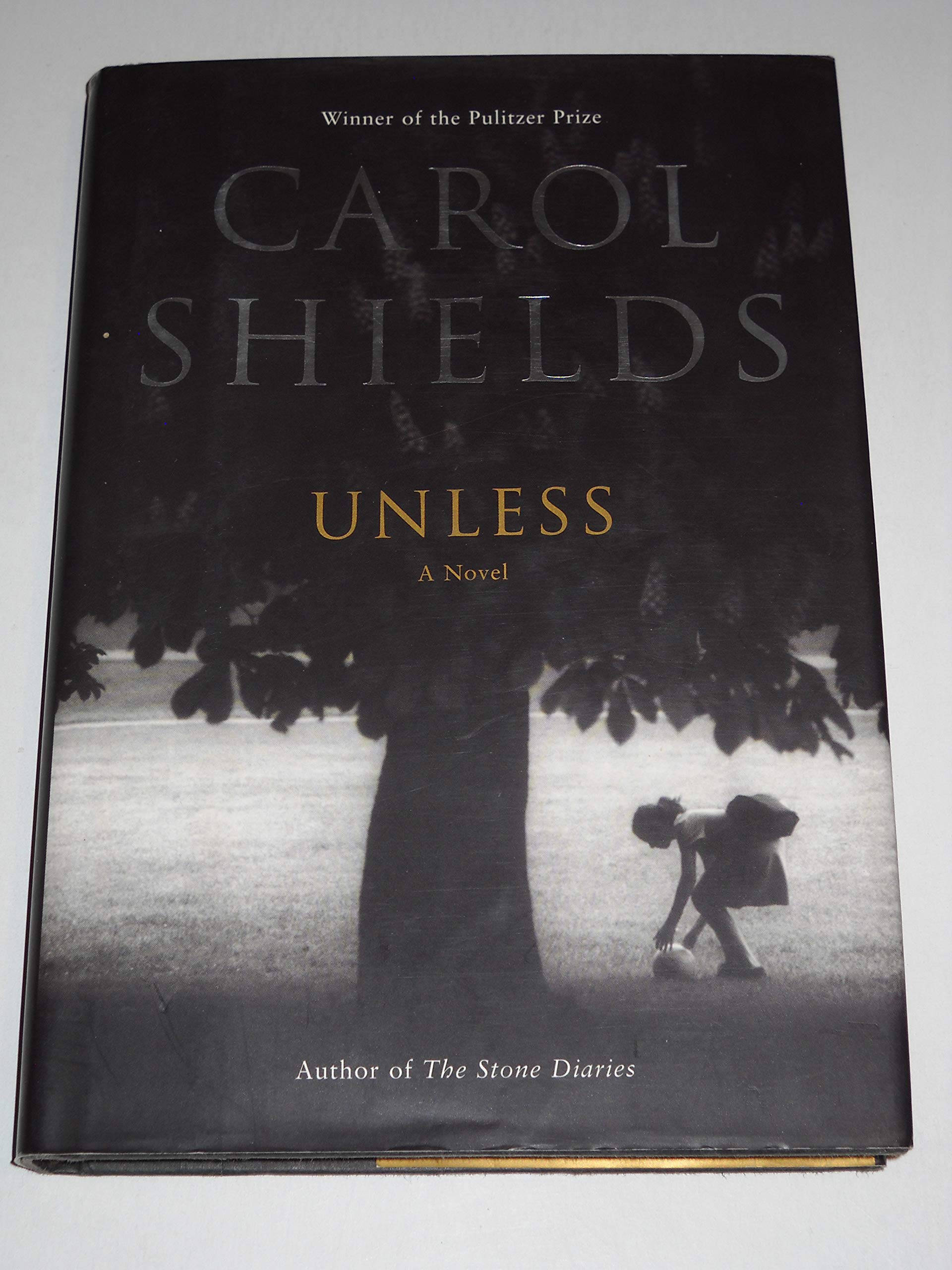
“Nothing short of astonishing.” ― New Yorker “A thing of beauty―lucidly written, artfully ordered, riddled with riddles and undergirded with dark layers of philosophical meditations.” ― Los Angeles Times For all of her life, 44 year old Reta Winters has enjoyed the useful monotony of happiness: a loving family, good friends, growing success as a writer of light 'summertime' fiction. But this placid existence is cracked wide open when her beloved eldest daughter, Norah, drops out to sit on a gritty street corner, silent but for the sign around her neck that reads 'GOODNESS.' Reta's search for what drove her daughter to such a desperate statement turns into an unflinching and surprisingly funny meditation on where we find meaning and hope. The final book from Pulitzer Prize-winner Carol Shields, Unless, is a harrowing but ultimately consoling story of one family's anguish and healing, proving Shields's mastery of extraordinary fictions about ordinary life. "A life is full of isolated events," writes Carol Shields near the end of Unless , "but these events, if they are to form a coherent narrative, require odd pieces of language to link them together, little chips of grammar (mostly adverbs or prepositions) that are hard to define... words like therefore , else , other , also , thereof , therefore , instead , otherwise , despite , already , and not yet ." Shield's explanation for her novel's title lends meaning to this multilayered narrative in which a mother's grief over a daughter's break with the family revises her feminist outlook and pushes her craft as a writer in a new direction. The oldest daughter of 44-year-old Reta Winters suddenly, inexplicably, drops out of college and ends up on a Toronto street corner panhandling, with a cardboard sign around her neck that reads "goodness." The quiet comforts of Reta's small-town life and the constancy of her feminist perspective sustain her hope that her daughter will snap out of this, whatever "this" is. Threaded into her family's crisis is her ongoing internal elegy on the exclusion of women from the literary canon, which she transposes to mean her daughter's exclusion from humanity. Reta wonders if her daughter has discovered, as she herself did years before, that the world is "an endless series of obstacles, an alignment of locked doors," and has chosen to pursue the one thing that doesn't require power or a voice: goodness. In her own writing, Reta reaffirms her own sense of self, as well as her sense of humor. As her theoretical reflections on modern womanhood play counterpoint to her unwavering sense of creating a home and keeping her family together, Reta's smarts and fears form a wonderfully coherent narrative--a life worth reading about. With Unless , the inaugural title in HarperCollins's Fourth Estate imprint, Shields (author of the Pulitzer Prize-winning novel The Stone Diaries ) once again asserts her place in the canon. --Emily Russin With yet another delectable investigation into human folly, Shields helps launch a new imprint at HarperCollins. Copyright 2002 Cahners Business Information, Inc. Reta Winters—loving helpmeet to a doctor, mother of three cheerful daughters, and author of a successful comic novel—has always considered herself happy, even blessed. Then her eldest child, nineteen-year-old Norah, briefly disappears and resurfaces as a panhandling mute on a Toronto street corner, holding up a homemade placard that says "Goodness." Shields's ability to use Reta's darkest fears to reveal the order lurking in chaos, without ever losing her light touch (Laurie Colwin comes to mind), is nothing short of astonishing. Copyright © 2005 The New Yorker Shields, author of the widely read, Pulitzer Prize-winning Stone Diaries (1994), is American-born but has lived in Canada since 1957, and her adopted homeland provides the setting for her latest novel. A gut-gripping story of one woman's difficult psychological journey, it becomes, in effect, a treatise on goodness and a testament to the several roles women must simultaneously shoulder. Reta Winters lives with her physician husband and three daughters in a farmhouse outside Orangetown, Ontario, an hour from Toronto. Well, all three of Reta's daughters used to live there; Norah, now 19, currently spends her time in silent contemplation, holding a begging bowl on a Toronto street corner. During the course of her anguish over her daughter's renunciation of her middle-class upbringing, Reta, a writer, tries to put life back into reasonable order in the pages of her new novel. Accepting that a daughter has "gone to goodness" is, ironically, a program of pain assuagement for Reta. Her need to bring her daughter back within the family fold arises from the very wellspring of motherhood, and the reader witnesses her attempted retrieval of happiness with open-hearted understanding. Shields shares with fellow Canadian Alice Munro not only her Ontario milieu but also a gift f