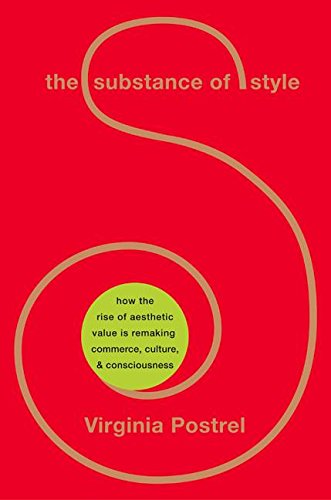
From airport terminals decorated like Starbucks to the popularity of hair dye among teenage boys, one thing is clear: we have entered the Age of Aesthetics. Sensory appeals are everywhere, and they are intensifying, radically changing how Americans live and work. We expect every strip mall and city block to offer designer coffee, a copy shop with do-it-yourself graphics workstations, and a nail salon for manicures on demand. Every startup, product, or public space calls for an aesthetic touch, which gives us more choices, and more responsibility. By now, we all rely on style to express identity. And aesthetics has become too important to be left to the aesthetes. In this penetrating, keenly observed book, Virginia Postrel shows that the "look and feel" of people, places, and things are more important than we think. Aesthetic pleasure taps deep human instincts and is essential for creativity and growth. Drawing from fields as diverse as fashion, real estate, politics, design, and economics, Postrel deftly chronicles our culture’s aesthetic imperative and argues persuasively that it is a vital component of a healthy, forward-looking society. Intelligent, incisive, and thought provoking, The Substance of Style is a groundbreaking portrait of the democratization of taste and a brilliant examination of the way we live now. It's enough to make your head hurt, this very conscious, contemporary, intellectual interpretation of Keats' "Beauty is life, life, Beauty." On the other hand, social scientist and author ( The Future and Its Enemies , 1998) Postrel brings together some very compelling arguments, insights, and examples about the value of aesthetics today. Nothing is quantified; instead, she points to qualitative examples like the GE Design Center in Selkirk, New York, devoted exclusively to the creation of new plastic forms. To Starbucks and the iMac, each a symbol of looks that sell--at a higher price. And to the 1,500-odd different drawer pulls available at the Great Indoors. Aesthetics is how we make the world around us special, a feature recognized as early as 1927, when adman Ernest Elmo Calkins opined about "Beauty the New Business Tool" in the Atlantic. It enhances communications (cf. PowerPoint) and identities (Hillary Clinton's hair). Ask any Afghan woman who risked prison to style her hair and paint her face; aesthetics is at one with life. Barbara Jacobs Copyright © American Library Association. All rights reserved “A brilliant analysis ... After reading The Substance of Style, the world will literally look different to you.” - Steven Pinker, Professor, MIT, and author of How the Mind Works and The Blank Slate “The Substance of Style does go a long way toward moving beauty out of the welter of political theory and into the realm of cultural reality.” - New York Times Book Review “Provocative. . . demolishes the false dichotomy between substance and style.” - Washington Post Book World “Marvelously informative…Brightly argued…Even when Postrel’s examples are familiar, the specifics can be eye-popping.…It’s groundbreaking.” - Atlantic Monthly “Virginia Postrel . . . writes perceptively about everything on which her penetrating gaze alights.” - George F. Will, Washington Post “A profoundly important book. The topic is absurdly under-studied; and Postrel has turned in a magnificent performance.” - Tom Peters, author of In Search of Excellence “[Postrel] connects a million seemingly disparate dots into a fresh, clear-eyed, persuasive picture of our culture circa 2003.” - Kurt Andersen, author of Turn of the Century “What a great read! It will heighten your awareness of our newly sculpted aesthetic world.” - Karim Rashid, designer “A work vast in its range, profound in its depth, rich in its detail.” - Robert Venturi, architect From airport terminals decorated like Starbucks to the popularity of hair dye among teenage boys, one thing is clear: we have entered the Age of Aesthetics. Sensory appeals are everywhere, and they are intensifying, radically changing how Americans live and work. We expect every strip mall and city block to offer designer coffee, a copy shop with do-it-yourself graphics workstations, and a nail salon for manicures on demand. Every startup, product, or public space calls for an aesthetic touch, which gives us more choices, and more responsibility. By now, we all rely on style to express identity. And aesthetics has become too important to be left to the aesthetes. In this penetrating, keenly observed book, Virginia Postrel shows that the "look and feel" of people, places, and things are more important than we think. Aesthetic pleasure taps deep human instincts and is essential for creativity and growth. Drawing from fields as diverse as fashion, real estate, politics, design, and economics, Postrel deftly chronicles our culture’s aesthetic imperative and argues persuasively that it is a vital component of a healthy, forward-looking society. Intelligent, incisive,