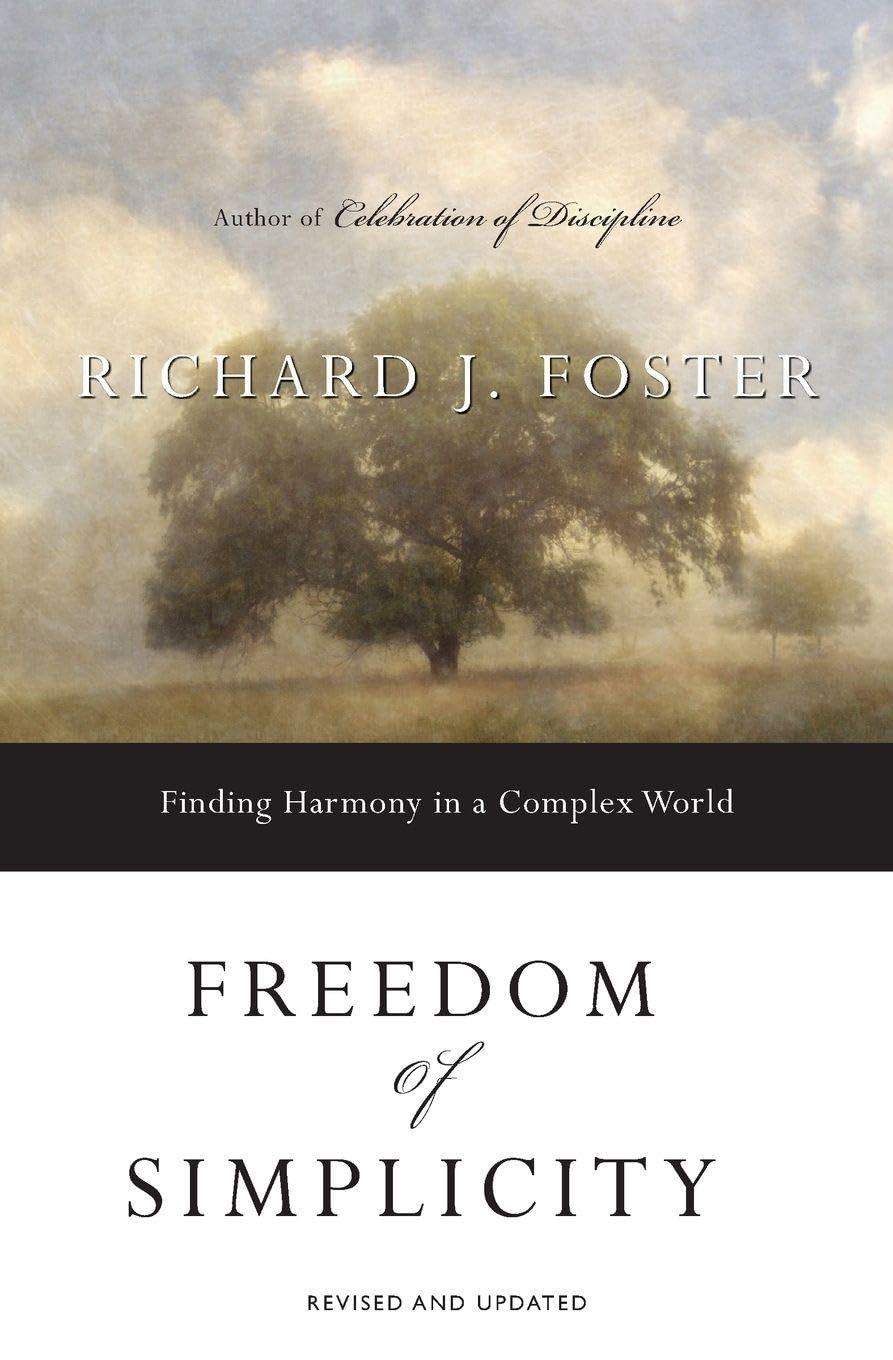
A revised and updated edition of the manifesto that shows how simplicity is not merely having less stress and more leisure but an essential spiritual discipline for the health of our soul. “Foster’s personal honesty, forthrightness, and literary courage are compelling.” - Ted Engstrom, president emeritus, World Vision “A stirring and timely message to Christians specifically and to humanity generally.” - Mark Hatfield, senator from Oregon “Belongs in the hearts and hands of all who call themselves Christ’s followers.” - David Allan Hubbard, president and professor of Old Testament, Fuller Theological Seminary “If everybody in this country could read―and heed―this book, what a difference it would make to the planet.” - Madeleine L'Engle “This book will become a challenging and formative part of your spiritual life.” - Lauren Winner, author of Girl Meets God and Real Sex: The Naked Truth About Chastity A revised and updated edition of the manifesto that shows how simplicity is not merely having less stress and more leisure but an essential spiritual discipline for the health of our soul. Richard J. Foster is the author of several bestselling books, including Celebration of Discipline , Streams of Living Water , Life with God , and Prayer , which was Christianity Today 's Book of the Year and the winner of the Gold Medallion Award from the Evangelical Christian Publishers Association. He is the founder of Renovaré, an organization and a movement committed to the renewal of the church of Jesus Christ in all its multifaceted expressions, and the editor of The Life with God Bible . Freedom of Simplicity Finding Harmony in a Complex World By Richard J. Foster HarperSanFrancisco Copyright © 2005 Richard J. Foster All right reserved. ISBN: 9780060759711 Chapter One The Complexity of Simplicity Seek simplicity -- and distrust it. -- Alfred North Whitehead Contemporary culture is plagued by the passion to possess. The unreasoned boast abounds that the good life is found in accumulation, that "more is better." Indeed, we often accept this notion without question, with the result that the lust for affluence in contemporary society has become psychotic: it has completely lost touch with reality. Furthermore, the pace of the modern world accentuates our sense of being fractured and fragmented. We feel strained, hurried, breathless. The complexity of rushing to achieve and accumulate more and more frequently threatens to overwhelm us; it seems there is no escape from the rat race. Christian simplicity frees us from this modern mania. It brings sanity to our compulsive extravagance, and peace to our frantic spirit. It liberates us from what William Penn called "cumber." It allows us to see material things for what they are -- goods to enhance life, not to oppress life. People once again become more important than possessions. Simplicity enables us to live lives of integrity in the face of the terrible realities of our global village. Christian simplicity is not just a faddish attempt to respond to the ecological holocaust that threatens to engulf us, nor is it born out of a frustration with technocratic obesity. It is a call given to every Christian. The witness to simplicity is profoundly rooted in the biblical tradition, and most perfectly exemplified in the life of Jesus Christ. In one form or another, all the devotional masters have stressed its essential nature. It is a natural and necessary outflow of the Good News of the Gospel having taken root in our lives. While it is important to stress that Christian simplicity is more than a mere reaction to the modern crisis, it should also be underscored that simplicity is keenly relevant to the massive problems of our world. We are witnessing poverty and starvation on a scale unprecedented in human history. By the time we fall asleep tonight another ten thousand individuals will have died of starvation -- over four hundred per hour. Many more millions live on the brink of extinction -- malnourished, aimless, desperate. It is difficult to relate to statistics, even when we know they represent precious ones for whom Christ died. But it is not hard to relate to the story of a man such as Kallello Nugusu, who had to sell his two oxen in order to buy food to keep his wife and six children alive when the famine struck Ethiopia. He then had no way to plow his fields and plant his crops, and the food was gone. When asked what he would do, he responded that he didn't know. Then, dropping his head into his hands, he said, "When my children cry because they are hungry, then it is very hard to be a father."' Though such accounts touch us deeply, we often feel helpless to do anything. How can we respond with any degree of integrity and effectiveness? It is the Discipline of simplicity that gives us the basis for developing a strategy of action that can address this and many other social inequities. Individual, ecclesiastical, and corporate action can sp