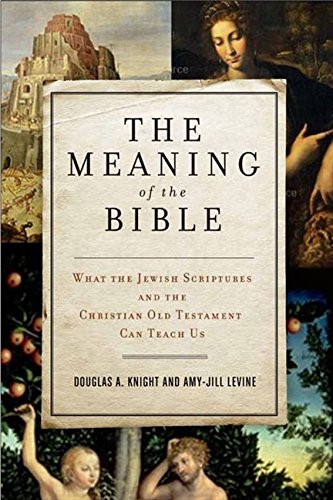
In this lively and fresh introduction to the scriptures of ancient Israel (what Christians call the Old Testament and Jews call the Tanakh), two preeminent biblical scholars, Douglas A. Knight and Amy-Jill Levine, combine their passion and expertise to examine not just what the Bible says but what it means . Through their eyes we see anew the Bibles literary brilliance, moral profundity, historical settings, and implications for our faiths and our future. Passed down for generations, compiled between 500 and 100 BCE, and finalized around the time of Jesus, the various accounts in the Hebrew Bible took shape under a variety of cultures. Drawing on their extensive biblical scholarship, Knight and Levine explore this diverse history and equip us with the critical tools necessary to understand what the ancient texts originally meant. With long experience in teaching candidates for the ministry as well as undergraduate and graduate students, they also explore the possible meanings the texts hold today for churches, synagogues, and anyone interested in the Bibles legacy. Knight and Levine begin with the broader biblical storyits historical context, literary artistry, and geographical setting. They then turn to the major biblical themes with which modern readers continue to wrestle: law and justice, human evil and Gods response, belief and practice, chaos and creation, war and peace, gender and sexuality, politics and economics, practical wisdom and apocalyptic vision. For each topic, they provide both general overviews and specific analyses of select biblical passages, explaining how and why their approaches reveal new insights and offering various strategies for informed interpretation. Throughout, Knight and Levine inspire us to ask new questions and develop a deeper understanding of one of the greatest collections of literature known to humankindas illuminating today as it was two thousand years ago. “From its superb introduction to its perfectly worded conclusion, this book does it all. Whether your interest in the Bible is historical or literary, specific texts or broad themes, this book has it―and conveys its relevance for today. The authors are learned, respected scholars who, above all, in giving their perspectives and interpretations, write clearly. Their uncomplicated, attractive style makes learning a pleasure. I recommend this book for general readers, for students, for teachers - well, basically, for everybody.” - Richard Elliott Friedman, author of Who Wrote the Bible? and The Bible Now “Amy-Jill Levine and Douglas A. Knight have combined to write a book on the Bible that is as academically brilliant as it is marvelously entertaining. By placing our scriptures into their original Jewish context they have opened up startling and profound new insights. This is a terrific book.” - John Shelby Spong, author of Re-Claiming the Bible for a Non-Religious World “Knight and Levine have written a winsome, accessible introduction to the theological thought of the Hebrew Bible. With a congenial exhibit of critical scholarship, they remain, in their thematic approach, at a descriptive level. But they allow room for and affirm the ways in which the biblical text can fund and form on-going interpretations in faith, both Jewish and Christian. This sort of irenic, thoughtful linkage of criticism and interpretation within a confessing tradition is exactly what we most need in Scripture reading.” - Walter Brueggemann, Professor Emeritus, Columbia Theological Seminary “A book we have needed for years - learned and accessible, clearly organized by the topics readers care about, and fully engaged with current discussions of deep and broad significance. It will ‘work’ everywhere and with everyone, Jews and Christians, committed or curious, in and out of the classroom. Knight and Levine know what they are talking about, and just as important, know how to talk about it.” - William Brosend, Executive Director, the Episcopal Preaching Foundation “If anyone thinks the fruit of biblical scholarship is esoteric and heavy reading, direct that person to this book. In it, Knight and Levine demonstrate both their scholarly proficiency and their expertise as seasoned educators. Unlike traditional introductions that focus primarily on historical, literary, or theological aspects of the Bible, here the material is treated thematically, with important historical, literary, and theological data woven together, thus revealing the rich yet complex character of the various themes. Despite the volume of information gathered in these pages, the authors have managed to present it in a style that is eminently readable without minimizing its multifaceted character. This book should appeal to a broad audience.” - Dianne Bergant, CSA, Catholic Theological Union “A helpful resource for both Jews and Christians, conservatives and liberals, religious leaders and social reformers. Its authors provide new knowledge on the Bible’s ri