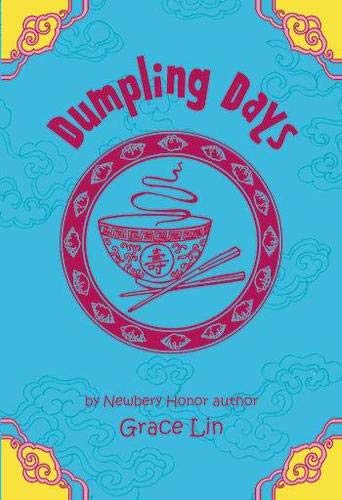
There was no day that dumplings couldn't make better . Pacy is back! The beloved heroine of The Year of the Dog and The Year of the Rat has returned in a brand new story. This summer, Pacy's family is going to Taiwan for an entire month to visit family and prepare for their grandmother's 60th birthday celebration. Pacy's parents have signed her up for a Chinese painting class, and at first she's excited. This is a new way to explore her art talent! But everything about the trip is harder than she thought it would be--she looks like everyone else but can't speak the language, she has trouble following the art teacher's instructions, and it's difficult to make friends in her class. At least the dumplings are delicious... As the month passes by, Pacy eats chicken feet (by accident!), gets blessed by a fortune teller, searches for her true identity, and grows closer to those who matter most. Amazon One-on-One: Grace Lin and Wendy Mass Wendy Mass is the author of A Mango-Shaped Space and Jeremy Fink and the Meaning of Life . Wendy Mass: Many of your books are based on your own childhood. How close are they to your real life? And why did you choose to do this? What does your family think? Grace Lin: The Year of the Dog , The Year of the Rat , and Dumpling Days are very much based on my real life. While they can’t truly be called memoirs, almost everything in those books was based on true-life experiences. I think I did this partially because I was following the old adage of "write what you know" and also because it was my homage to the books that I loved as a child-- Little Women [by Louisa May Alcott], Betsy-Tacy [by Maud Hart Lovelace], and the Little House books [by Laura Ingalls Wilder]. In those books, the authors very much wrote about their own lives, and knowing that those events were probably true made the books that much more magical to me. My family enjoys being in my books. In fact, it was one of my sisters who "encouraged" it. My first published book was The Ugly Vegetables , a picture book about how my mother and I grew Chinese vegetables while the rest of the neighbors grew flowers. Well, I didn’t put my sisters in that book, and they were very annoyed with me. "When did you become an only child?" one accused, and they made me promise I would always include them in any other books about our family. You can see from my other books-- Dim Sum for Everyone! to, now, Dumpling Days --that I’ve kept that promise--so far! Mass: I am sure you often hear from readers about how they can identify with your characters’ experiences and feeling like they don’t quite fit in. Is there a particular comment or response that means a lot to you? Lin: There isn’t a specific comment that means a lot, but there is a particular emotion behind certain readers that I treasure. Recently, I was at a book fair where I had to do a reading on a gigantic stage, competing with bands, games, cotton candy, costumed characters, etc., for attention. Only a handful of kids watched me, and I felt a little discouraged. But afterwards, one of those kids ran up to me with a bag filled with my books. I was her favorite author, and she had made her mother drive an hour to come to the fair just to see me! It was so amazing that my books had meant that much to her. I realized that for my books to truly touch a reader, even if it’s just one, is something to cherish, be thankful for--and not to forget! Mass: In Dumpling Days , Pacy and her family visit Taiwan for a month. You did such a wonderful job bringing us the sights and sounds and especially tastes of the country. What made you decide to focus on the food? It made me want to run out and try soup dumplings! Lin: You should definitely try soup dumplings, they are so good! Honestly, I write about the things that I like to read--and I love reading about food! Farmer Boy [by Laura Ingalls Wilder] was one of my favorite books as a child, and I guess in some ways, Dumpling Days is an homage to that! But, also, food is a very important part of Taiwanese culture, and there was no way I could accurately portray the culture without including a lot of food. It truly is a defining characteristic in Taiwan. There, when you first greet someone, instead of saying "Hello," you say "Have you eaten yet?" Mass: Describing a country so different from America must have been a huge challenge. What kind of research did you do? Lin: Well, much of it was based on my own memories of visiting Taiwan with my parents. I went through a lot of photo albums, talked to my parents (who in turn talked to my grandmother and other relatives), and in 2008, I went back to Taiwan for a visit to fill in some of the blanks. There, I got to retaste things like stinky tofu (still not a fan) and see Taipei 101 (which didn’t exist when I went as a child), and got my own "glamour" photos done. That was a hilarious and fun experience that I was glad I got to put in the book--and I used one of th