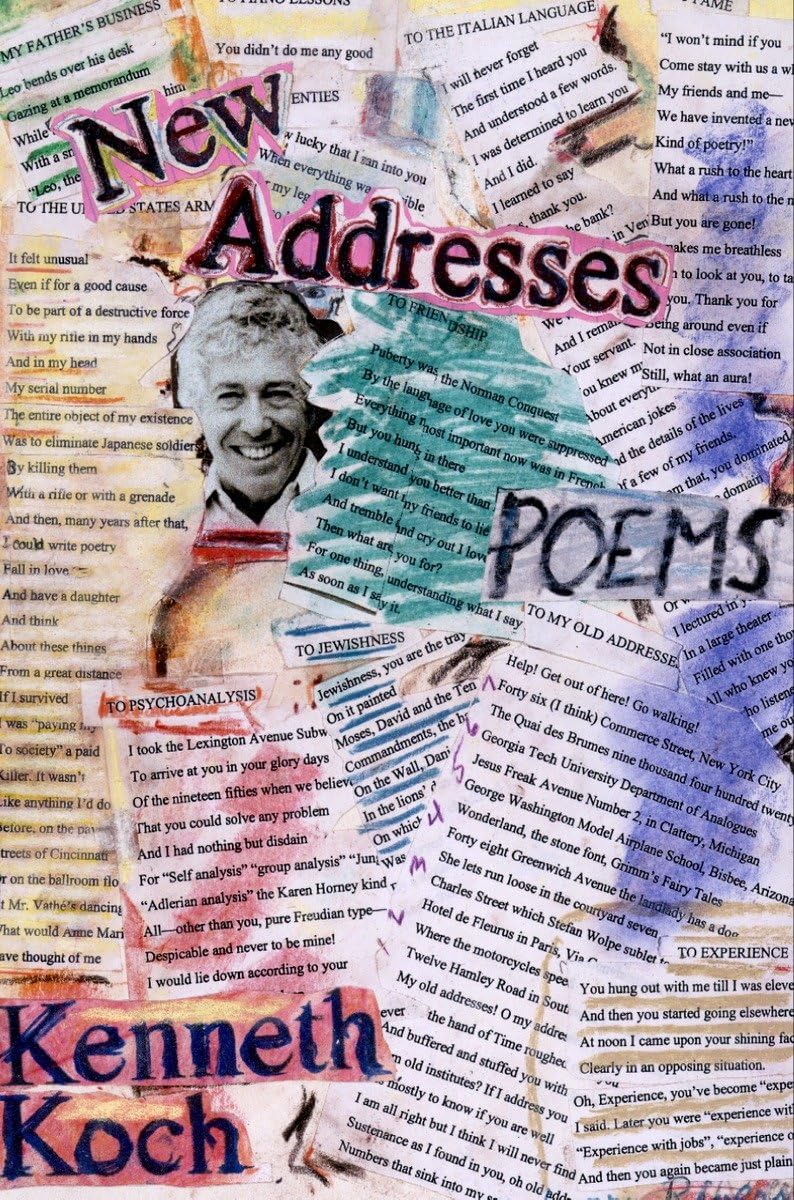
Kenneth Koch, who has already considerably "stretched our ideas of what it is possible to do in poetry" (David Lehman), here takes on the classic poetic device of apostrophe, or direct address. His use of it gives him yet another chance to say things never said before in prose or in verse and, as well, to bring new life to a form in which Donne talked to Death, Shelley to the West Wind, Whitman to the Earth, Pound to his Songs, O'Hara to the Sun at Fire Island. Koch, in this new book, talks to things important in his life -- to Breath, to World War Two, to Orgasms, to the French Language, to Jewishness, to Psychoanalysis, to Sleep, to his Heart, to Friendship, to High Spirits, to his Twenties, to the Unknown. He makes of all these "new addresses" an exhilarating autobiography of a most surprising and unforeseeable kind. , who has already considerably "stretched our ideas of what it is possible to do in poetry" (David Lehman), here takes on the classic poetic device of apostrophe, or direct address. His use of it gives him yet another chance to say things never said before in prose or in verse and, as well, to bring new life to a form in which Donne talked to Death, Shelley to the West Wind, Whitman to the Earth, Pound to his Songs, O'Hara to the Sun at Fire Island. Koch, in this new book, talks to things important in his life -- to Breath, to World War Two, to Orgasms, to the French Language, to Jewishness, to Psychoanalysis, to Sleep, to his Heart, to Friendship, to High Spirits, to his Twenties, to the Unknown. He makes of all these "new addresses" an exhilarating autobiography of a most surprising and unforeseeable kind. From the Hardcover edition. Kenneth Koch, who has already considerably "stretched our ideas of what it is possible to do in poetry" (David Lehman), here takes on the classic poetic device of apostrophe, or direct address. His use of it gives him yet another chance to say things never said before in prose or in verse and, as well, to bring new life to a form in which Donne talked to Death, Shelley to the West Wind, Whitman to the Earth, Pound to his Songs, O'Hara to the Sun at Fire Island. Koch, in this new book, talks to things important in his life -- to Breath, to World War Two, to Orgasms, to the French Language, to Jewishness, to Psychoanalysis, to Sleep, to his Heart, to Friendship, to High Spirits, to his Twenties, to the Unknown. He makes of all these "new addresses" an exhilarating autobiography of a most surprising and unforeseeable kind. "From the Hardcover edition. Kenneth Koch has published many volumes of poetry, including New Addresses , Straits and One Train . He was awarded the Bollingen Prize for Poetry in 1995, in 1996 he received the Rebekah Johnson Bobbitt National Prize for Poetry awarded by the Library of Congress, and he received the first Phi Beta Kappa Poetry award in November of 2001. His short plays, many of them produced off- and off-off-Broadway, are collected in The Gold Standard: A Book of Plays . He has also written several books about poetry, including Wishes, Lies, and Dreams; Rose, Where Did You Get That Red? ; and, most recently, Making Your Own Days: The Pleasures of Reading and Writing Poetry . He taught undergraduates at Columbia University for many years. He died in 2002. TO JEWISHNESS As you were contained in Or embodied by Louise Schlossman When she was a sophomore At Walnut Hills High School In Cincinnati, Ohio, I salute you And thank you For the fact That she received My kisses with tolerance On New Year's Eve And was not taken aback As she well might have been Had she not had you And had I not, too. Ah, you! Dark, complicated you! Jewishness, you are the tray On it painted Moses, David and the Ten Commandments, the handwriting On the Wall, Daniel In the lions' den On which my childhood Was served By a mother And father Who took you To Michigan Oh the soft smell Of the pine Trees of Michigan And the gentle roar Of the Lake! Michigan Or sent you To Wisconsin I went to camp there On vacation, with me Every year! My counselors had you My fellow campers Had you and "Doc Ehrenreich" who Ran the camp had you We got up in the Mornings you were there You were in the canoes And on the baseball Diamond, everywhere around. At home, growing Taller, you Thrived, too. Louise had you And Charles had you And Jean had you And her sister Mary Had you We all had you And your Bible Full of stories That didn't apply Or didn't seem to apply In the soft spring air Or dancing, or sitting in the cars To anything we did. In "religious school" At the Isaac M. Wise Synagogue (called "temple") We studied not you But Judaism, the one who goes with you And is your guide, supposedly, Oddly separated From you, though there In the same building, you In us children, and it On the blackboards And in the books Bibles And books simplified From the Bible. How Like a Bible with shoulders Rabbi Seligmann is! You kept my parents and me Out of hotels near