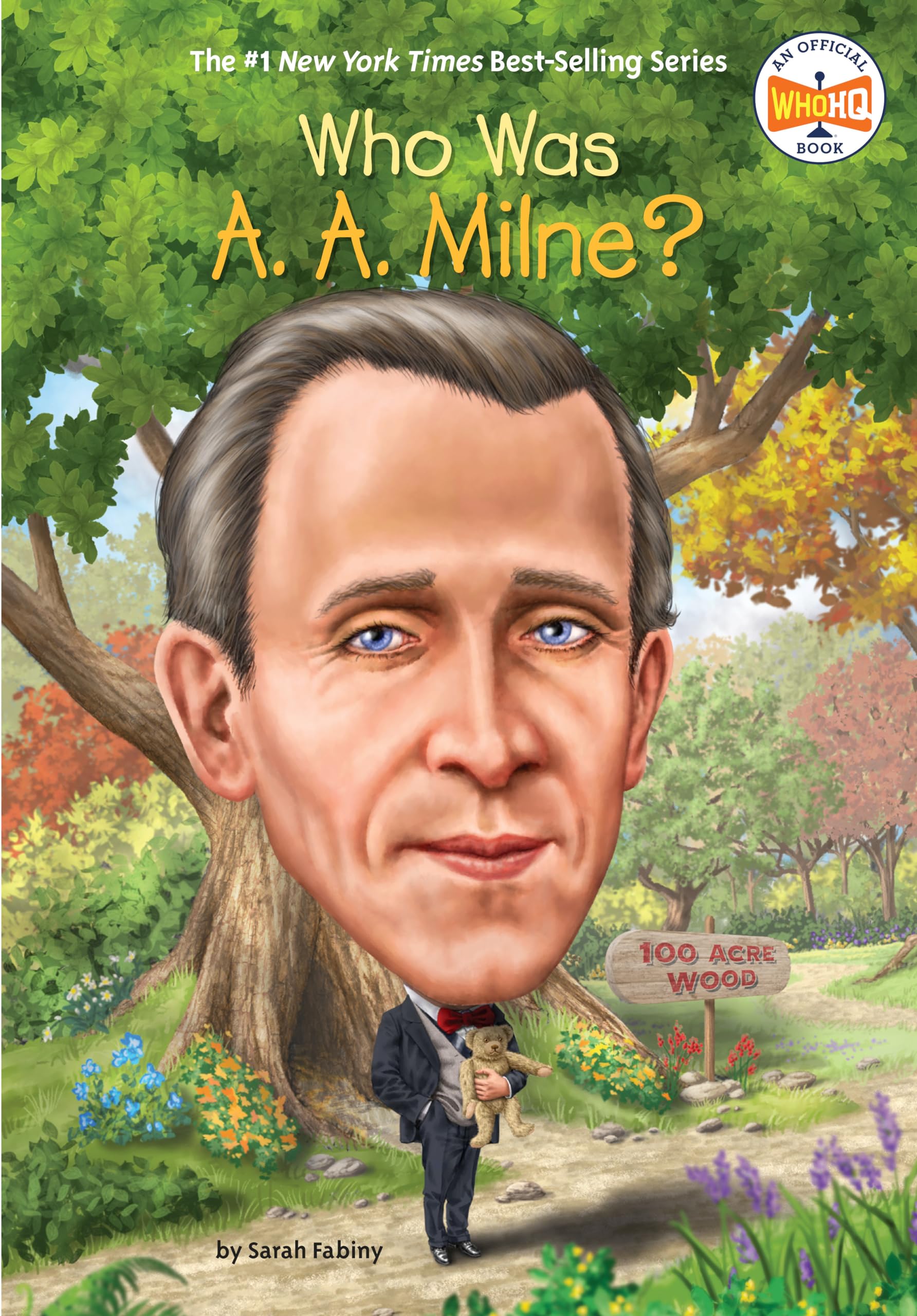
Find out how stories about his son's stuffed bear, famously known as Winnie the Pooh, made A. A. Milne one of the world's best-known children's authors in this informative biography from the #1 New York Times Best-Selling Series , Who Was?. Born in England in 1882, Alan Alexander Milne grew up with a love for exploring the woods with his brother and writing poems about their adventures. Alan carried that love into his adult life by exploring the woods with his son, Christopher Robin. Well known for his articles, plays, and novels, Alan considered himself a "serious" author. But one story about a stuffed bear changed his image forever. Inspired by his son and their time playing in the woods, Alan wrote a story about Christopher Robin and his stuffed bear, Winnie-the-Pooh, on a hunt for honey. The story was an instant success, and soon everyone wanted to hear more about the boy, his bear, and the magical Hundred Acre Wood. Today, children all around the world still read his stories in the classic books Winnie-the-Pooh , The House at Pooh Corner , Now We Are Six , and When We Were Very Young . Sarah Fabiny has written several Who Was? titles, including biographies of Beatrix Potter, Frida Kahlo, Rachel Carson, and Gloria Steinem. It was the end of 1925, and Christmas was just around the corner. Alan Milne’s wife and son were getting ready for the holiday, but Mr. Milne was distracted. He had been asked to write a children’s story for the Evening News, a newspaper in London, England, and he was struggling to come up with an idea. Known for writing plays and novels, he thought of himself as a “serious” writer, but he agreed to write one children’s story for the Christmas edition of the paper. His wife, Daphne, told him that it was easy—-all he needed to do was write down any of the bedtime stories he told their son, Christopher Robin. Alan, who wrote under the name “A. A. Milne,” was a fantastic storyteller and told his son tales of dragons, giants, and magic rings almost every night. But there was one story about a boy and his teddy bear that he thought people might find especially interesting. So he got right to work, writing down the familiar bedtime story. He decided to name the boy in the story Christopher Robin, after his son. As for the bear, Christopher Robin had a teddy bear named Edward Bear. Could Alan use that name, also? No, it was too ordinary. He wanted the bear in his story to have a more unusual, silly, and memorable name. He named the bear Winnie--the--Pooh. And although he didn’t know it yet, this bear would soon become the most famous and loved bear in children’s literature. Chapter 1 Meet the Milnes Alan Milne, aged two and a half, quietly played with his toys while his older brothers, Barry and Ken, aged five and almost four, were in the middle of a reading lesson. Their father came to check on the older boys and their studies. He pointed to a word on the blackboard in front of them and asked his sons to read it aloud. The two boys were silent—-they hadn’t been paying attention to the lesson. But from the corner of the room, their younger brother answered, “I can do it.” Their father pointed to the word again. “Cat,” Alan said. Mr. Milne smiled at his youngest son. The boy was right. Alan Alexander Milne was born in London, England, on January 18, 1882. His mother had been a teacher, and his father ran a school for boys called Henley House. Education was an important part of the Milnes’ lives—-they even lived in the same building as Henley House. John Milne was a kind and caring teacher. He wanted his students to learn as much as they could and have fun, too. Most boys started at the school when they were seven years old, including his sons Ken and Barry. But Alan was ready to start school when he was just six years old. The three brothers were all good students, but Alan was the brightest. Alan was very excited to be at school with his brothers, especially Ken, whom he looked up to. The two were very close and did almost everything together. While their father made sure they did their schoolwork, he also encouraged them to “keep out of doors as much as you can, and see all you can of nature.” And that’s exactly what the brothers did. They went for long walks and bike rides, and they shared all their secrets. Sometimes they would even pretend they were the only people left on Earth and were free to do whatever they wanted. They let their imaginations run wild. When Alan was seven years old, a new teacher came to teach science and math at Henley House. H. G. Wells would later become one of the world’s most famous science--fiction writers. But at Henley House, he challenged the young boys to solve difficult math problems and research interesting science topics. He helped Alan discover a love of math. But math wasn’t the only thing Alan focused on at Henley House. The school published a magazine, and he began writing articles for it when he was nine