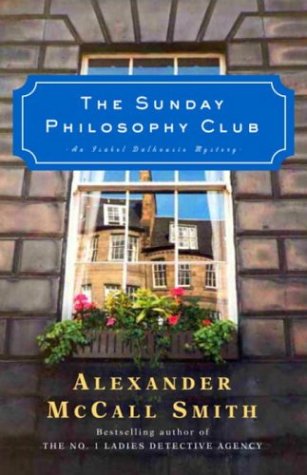
Introducing the new series from the international bestselling author of The No. 1 Ladies’ Detective Agency books — the Sunday Philosophy Club series is set in Edinburgh, Scotland, and stars Isabel Dalhousie, editor of The Review of Applied Ethics and part-time detective. Isabel enjoys wading through the mysteries of life, everything from the morning’s crossword to higher philosophical dilemmas, often with the advice of her ethically upright housekeeper, Grace. In this first novel of the series, Isabel witnesses a young man plunge to his death from the upper balcony of the Edinburgh Concert Hall. When Isabel discovers that the young victim had uncovered illicit activities at the brokerage house where he worked, the hunt for answers, and the killer, is on. This new series is a delightful look at a reasonable and logical woman who keeps getting involved in mysteries despite all reason and logic. Praise for Alexander McCall Smith: “There’s no mystery as to why Alexander McCall Smith’s books are everywhere. . . . His works are engaging, delightful events, immersing readers in a world that is foreign, yet familiar, where good people try to do their best in life, with mixed results.” — Calgary Herald “[McCall Smith’s books] are closer to being moral fables, fascinating explorations of guilt and conscience and reparation and atonement.” — The Vancouver Sun Introducing the new series from the international bestselling author of The No. 1 Ladies' Detective Agency books — the Sunday Philosophy Club series is set in Edinburgh, Scotland, and stars Isabel Dalhousie, editor of The Review of Applied Ethics and part-time detective. Isabel enjoys wading through the mysteries of life, everything from the morning's crossword to higher philosophical dilemmas, often with the advice of her ethically upright housekeeper, Grace. In this first novel of the series, Isabel witnesses a young man plunge to his death from the upper balcony of the Edinburgh Concert Hall. When Isabel discovers that the young victim had uncovered illicit activities at the brokerage house where he worked, the hunt for answers, and the killer, is on. This new series is a delightful look at a reasonable and logical woman who keeps getting involved in mysteries despite all reason and logic. Praise for Alexander McCall Smith: "There's no mystery as to why Alexander McCall Smith's books are everywhere. . . . His works are engaging, delightful events, immersing readers in a world that is foreign, yet familiar, where good people try to do their best in life, with mixed results." -- Calgary Herald "[McCall Smith's books] are closer to being moral fables, fascinating explorations of guilt and conscience and reparation and atonement." -- The Vancouver Sun Alexander McCall Smith is professor of medical law at the University of Edinburgh. He was born in what is now known as Zimbabwe and taught law at the University of Botswana. He is the author of over fifty books on a wide range of subjects, including specialist titles such as Forensic Aspects of Sleep and The Criminal Law of Botswana , children’s books such as The Perfect Hamburger , and a three-part series called Portuguese Irregular Verbs. Chapter One Isabel Dalhousie saw the young man fall from the edge of the upper circle, from the gods. His flight was so sudden and short, and it was for less than a second that she saw him, hair tousled, upside down, his shirt and jacket up around his chest so that his midriff was exposed. And then, striking the edge of the grand circle, he disappeared headfirst towards the stalls below. Her first thought, curiously, was of Auden's poem on the fall of Icarus. Such events, said Auden, occur against a background of people going about their ordinary business. They do not look up and see the boy falling from the sky. I was talking to a friend, she thought. I was talking to a friend and the boy fell out of the sky. She would have remembered the evening, even if this had not happened. She had been dubious about the concert-a performance by the Reykjavik Symphony, of which she had never heard-and would not have gone had not a spare ticket been pressed upon her by a neighbour. Did Reykjavik really have a professional symphony orchestra, she wondered, or were the players amateurs? Of course, even if they were, if they had come as far as Edinburgh to give a late spring concert, then they deserved an audience; they could not be allowed to come all the way from Iceland and then perform to an empty hall. And so she had gone to the concert and had sat through a first half which comprised a romantic combination of German and Scottish: Mahler, Schubert, and Hamish McCunn. It was a warm evening-unseasonably so for late March-and the atmosphere in the Usher Hall was close. She had come lightly dressed, as a precaution, and was glad that she had done so as the temperature in the grand circle inevitably climbed too high. During the interval she had made her way downstairs and h