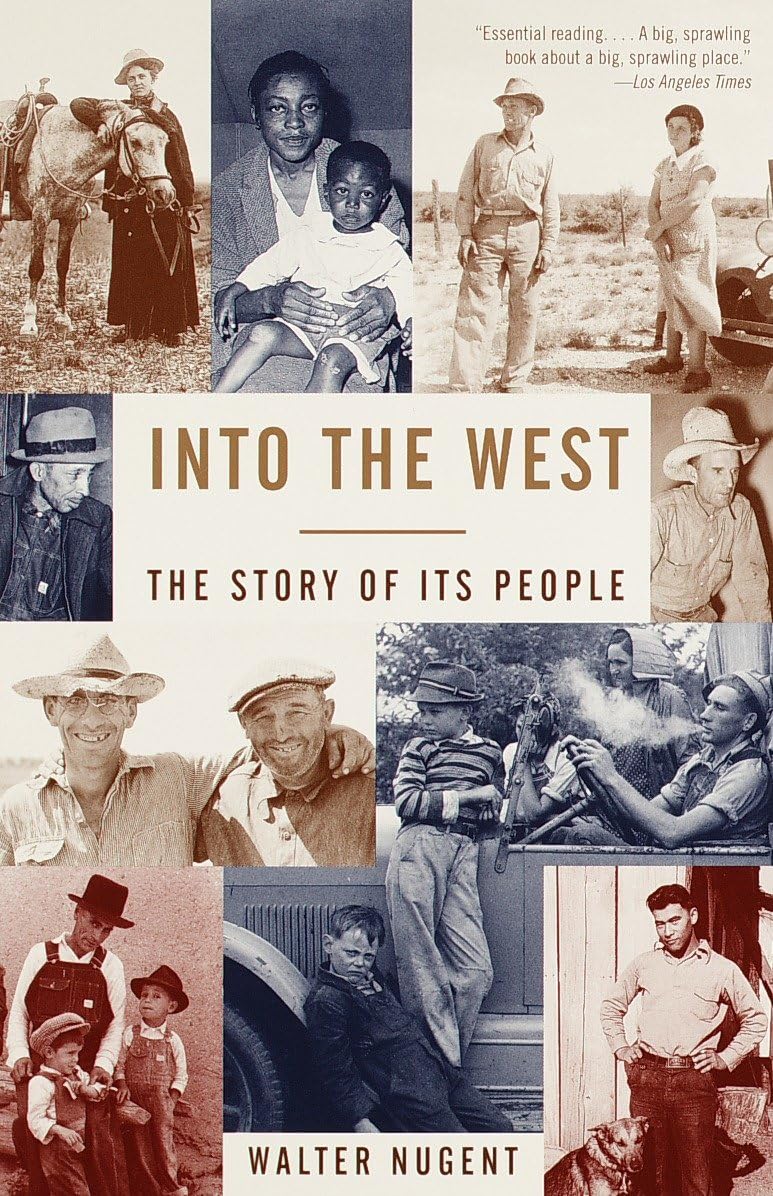
Acclaimed historian Walter Nugent brings us what is perhaps the most comprehensive and fascinating account to date of the peopling of the American West. In this epic social-demographic history, Nugent explores the populations of the West as they grow, change and intersect from the Paleo-Indians, the Spanish Conquistadors, to displaced Okies, wartime African American immigrants, and all the disparate groups that have made California the most ethnically diverse state in the union. Their tale, in all its complexity, is a tale that surprises, that subverts traditional stereotypes and that illuminates the multifaceted character of one of the world’s most unique and dynamic territories. "Essential reading.... A big, sprawling book about a big, sprawling place.... In notable ways, it departs from earlier versions of 'How the West was won'."- The Los Angeles Times storian Walter Nugent brings us what is perhaps the most comprehensive and fascinating account to date of the peopling of the American West. In this epic social-demographic history, Nugent explores the populations of the West as they grow, change and intersect from the Paleo-Indians, the Spanish Conquistadors, to displaced Okies, wartime African American immigrants, and all the disparate groups that have made California the most ethnically diverse state in the union. Their tale, in all its complexity, is a tale that surprises, that subverts traditional stereotypes and that illuminates the multifaceted character of one of the world s most unique and dynamic territories. storian Walter Nugent brings us what is perhaps the most comprehensive and fascinating account to date of the peopling of the American West. In this epic social-demographic history, Nugent explores the populations of the West as they grow, change and intersect from the Paleo-Indians, the Spanish Conquistadors, to displaced Okies, wartime African American immigrants, and all the disparate groups that have made California the most ethnically diverse state in the union. Their tale, in all its complexity, is a tale that surprises, that subverts traditional stereotypes and that illuminates the multifaceted character of one of the world’s most unique and dynamic territories. Walter Nugent has taught history at the University of Notre Dame since 1984 and, before that, was Professor of History at Indiana University for twenty-one years. As a visiting professor he has also taught and lived in England, Israel, Germany, Poland, and Ireland. He has published eight previous books and well over a hundred essays and reviews on American and comparative history. He lives with his wife, the historian Suellen Hoy, in Chesterton, Indiana. The Mysterious West In 1976 the cartoonist Saul Steinberg drew a famous cover for the New Yorker showing the locals' mind's-eye-view of the United States. Looking westward from midtown, the Manhattanite saw, close up, Ninth Avenue, then Tenth, then the Hudson, and then, in fast-closing perspective, vagueness, error, and finally dismissal. If Steinberg had drawn for the Los Angeles Times , he would have produced a much different map. It would have highlighted the Big Bear Lake ski area, Las Vegas, and Lake Tahoe; Sacramento and San Francisco; Phoenix, Denver, and Seattle; Washington, D.C.; and not much of New York except Wall Street and the theater district. But the map would certainly have shown London, Paris, and Rome and, looking west, Hawaii, Australia, and Japan. Mexico, definitely. Even in the West, however, people have strange ideas about their own region. Sophisticated and case-hardened editors of metropolitan dailies on the Pacific Coast do not believe that anything east of the Rocky Mountains is really part of the West. Conversely some residents of Billings, Boulder, or Boise -- the interior West -- think that California, Oregon, and Washington are outside the West. Such people would prefer that any place west of the Sierras should break off and float out into the Pacific. They think that the "real" (meaning, ideal) West no longer exists, that it has already gone to metropolitanized hell. For them, what is left might as well be strip-mined, deforested, overgrazed, desertified, and paved over because the "true West" can never be found again except in the pages of writers like Louis L'Amour, Larry McMurtry, and the earlier Zane Grey and Owen Wister. To this way of thinking, the West is myth, memory, imagination, not a place at all, because the place that is now there has too many cities, too many people, and hardly any buffaloes or cowboys. But it is a place, with people more diverse in race or class than those of the other great regions of the United States: the Northeast, the Midwest, and the South. They are more varied today than they used to be, but they have always been a mixed lot, not just cigarette-smoking cowboys or hippies on beaches. This book is one story about the people of the West: who they are and have been, how they got there, what