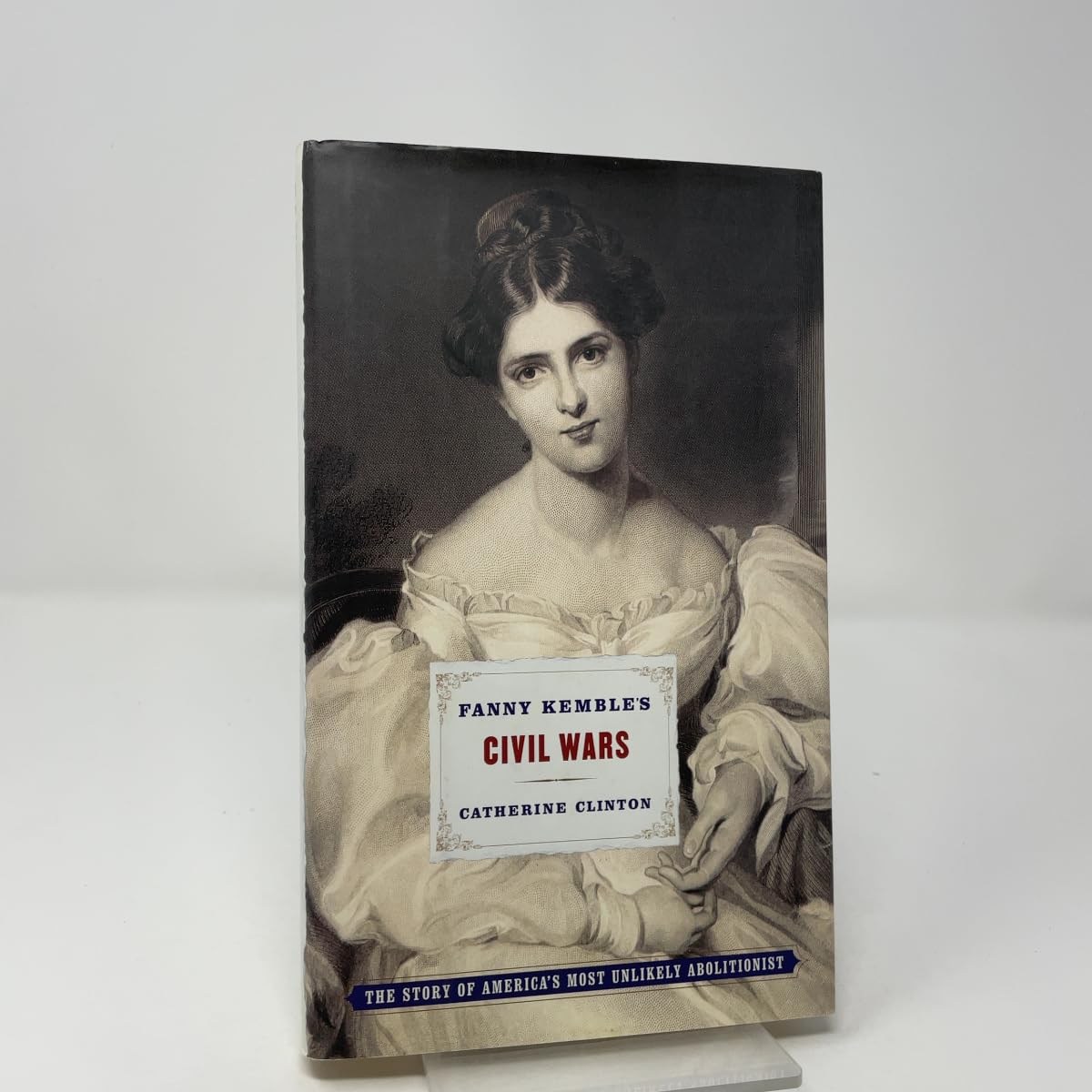
The life of British stage actress and abolitionist Fanny Kemble follows this remarkable woman from England to Georgia, where, as a "plantation mistress" she wrote fiery tracts against slavery. Fanny KembleDEnglish-born actress, author, and abolitionistDcommanded center stage in the American drama over slavery and in her much-publicized personal civil wars of marriage to one of America's wealthiest slaveholders, bitter divorce, and publication of her private letters and her antislavery journal describing life on a Georgia plantation. Clinton (history, Baruch Coll.), the author of numerous books on Southern women, casts Kemble in a sympathetic light as a woman trapped by family and fame, even as she cultivated both, and as a metaphor for the battle over reform, marital relations, and slavery argued on both sides of the Atlantic. Clinton's great contribution to the thick literature on slavery, Kemble, and gender is to give Kemble her own voice and to offer original readings of Kemble's many writings. That the proslavery secessionist Butler comes off as a cad is no surprise, but that Clinton discovers Kemble's own flaws of ego and emotion gives her work a unique credibility. So, too, does Clinton's deft handling of the tangled Butler family history. Clinton's eloquent history is not quite Tara recast, but it is better than any fiction on the subject and should give Kemble a new audience in a new century. Highly recommended. Randall M. Miller, Saint Joseph's Univ., Philadelphia Copyright 2000 Reed Business Information, Inc. Born to an English theatrical family, Frances Anne Kemble was a Shakespearean sensation in London in her early twenties, circa 1830. She also was a tireless diarist, letter-writer, and author whose life intersected with slavery, the Civil War, and Reconstruction. Profiting from this source material, Clinton describes a woman barely contained by the social straitjackets of her times: a determined, highly intelligent woman, she questioned slavery and the legal dominion of husbands over wives. Because of her family's financial straits, she and her actor-father toured America in the early 1830s to great success; success (and acidulous reviews) also met the journal she published of those rough American democrats. Yet this budding literary career halted when she married a slaveowner named Pierce Butler, who demanded that she retire from the stage and publishing and attend to motherhood. The balance of Clinton's story traces the inevitable collapse of the Butler-Kemble mismatch, Fanny's relations with her daughters, and post-war literary life. A rounded portrait of a tempestuous life. Gilbert Taylor Copyright © American Library Association. All rights reserved Doris Kearns Goodwin historian and biographer This is a beautifully written, brilliantly intuitive, and immensely readable biography of one of the most fascinating women of the nineteenth century. The historical research is original and first-rate, while the story completely captured my heart. -- Review Catherine Clinton is the author of more than a dozen works of history. Since earning her Ph.D. from Princeton, she has taught at colleges and universities including Brandeis, Brown, Harvard, and the University of Richmond. She is an elected member of the Screen Writers Guild. She lives in Greenwich, Connecticut. Chapter One: Enter Fanny Kemble In 1809 Frances Anne Kemble was born into the most celebrated theatrical family in Europe. The decade of her birth, known among historians of the British theater as the Kemble era, marked the convergence of a powerful theatrical dynasty and the triumphant ascendancy of theater as an art form. Led by patriarch Roger Kemble, the Kemble clan spearheaded the campaign waged by British actors throughout the eighteenth century to bring the theater into the rarefied circle of artistic esteem long accorded opera, ballet, and orchestral performances. Striving to reverse the prejudices his craft had faced for centuries, Kemble was steadfast in his efforts to help managers secure theater permits and establish permanent homes for acting companies. And he railed against the long-held stereotype that women who pursued careers on the stage were hardly a cut above the courtesans who filled the third tier of the gallery. Roger Kemble defied that opinion in a most personal way, by taking an actress as his bride. He married Sarah Ward, the daughter of a popular actor acclaimed for his 1746 benefit performance at Stratford, Shakespeare's birthplace, to raise funds for the restoration of a monument to the playwright. The Kemble affinity for Shakespeare -- so evident in the superb performances of Roger's granddaughter Fanny Kemble -- had its roots in the world of eighteenth-century traveling troupes. At that time, a royal license was required to operate a theater, and London supported just two patents: Covent Garden and the Drury Lane. Further, the Act of 1737 forbade performing plays for profit outside London, for