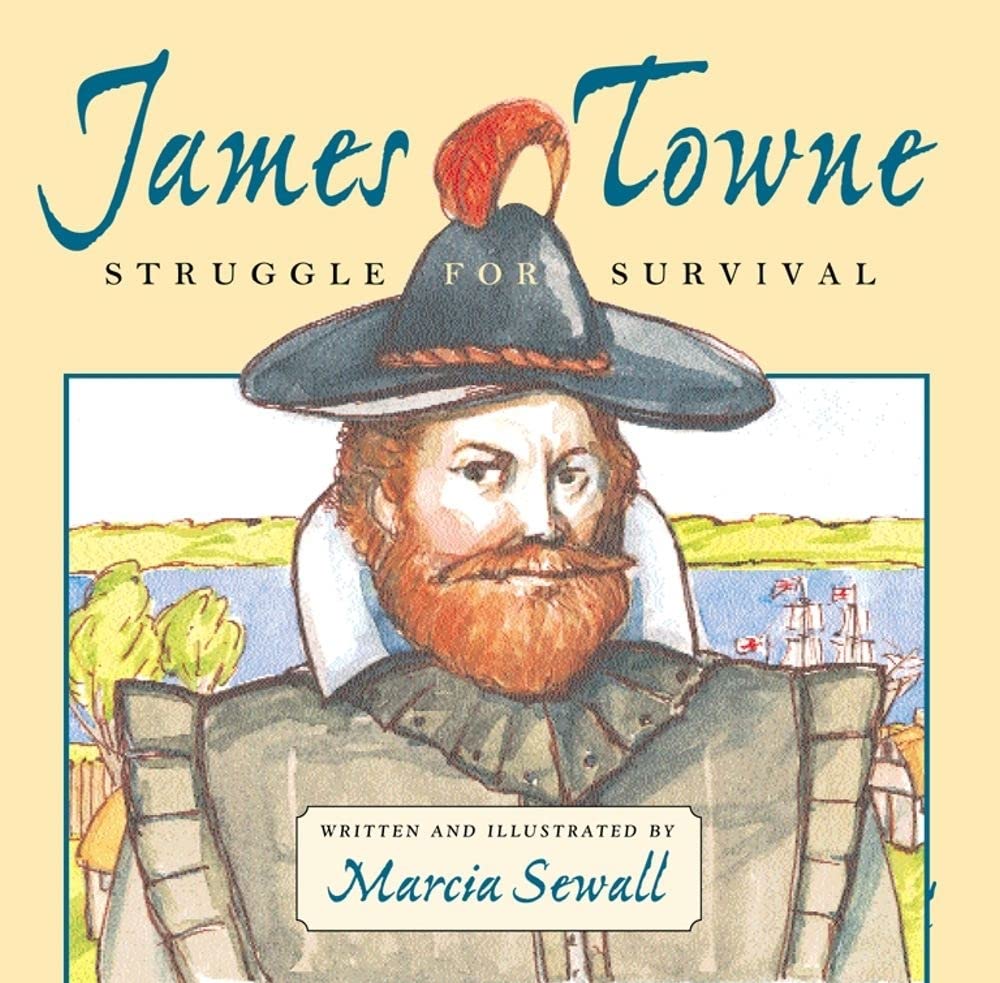
This moving account of James Towne's difficult early years is told from the viewpoint of one of its settlers and enhanced by original quotations. During the first summer of 1607, half the James Towne colony died; food was scarce, and the settlers battled oppressive heat and sickness. Over the next few years, supply ships from England became the colony's lifeline, as they brought much-needed stores of food and carried back offerings from the new land, as well as the settlers' homesick letters. Conditions began to improve when Captain John Smith was elected president of the colony, and James Towne soon doubled in size. While some of the settlers had been reluctant to work, Smith required participation from all, and the colonists began to take pride in improving their conditions. Furthermore, by learning the native language and befriending a Native American girl named Pocahontas, Smith was able to establish, temporarily, an uneasy peace between the settlers and the natives whose land they had taken. As new settlers began to arrive from England though, the resources of the budding colony were strained, and in the autumn of 1609 the colony suffered a Starving Time. Deciding to abandon James Towne at last, the colonists headed back toward England, only to have their journey intercepted by a messenger, who informed the settlers that new leaders sent by the King were due to arrive in the flailing colony any day, and urged them to return. Not for long after their arrival, the discouraged James Towne colonists were met by a new governor and a ship full of healthy passengers with enough supplies and hope to work together to ensure James Towne's survival. Gr 3-5-Using the same format as in the People of the Breaking Day (Atheneum, 1990), Sewall offers a glimpse into life in the Jamestown Colony. Told through the voice of an 18-year-old carpenter, the narrative opens with a description of the departure of three ships from England on December 20, 1606. Readers follow the voyagers as they sail across the Atlantic, find landfall, establish a settlement, and meet with the native people. The clear narration retains the tone of 17th-century English. Short paragraphs, often defined by dates, tell of the difficult early years of the settlement. Quotes from diaries and letters (though not always identified as such) with authors and dates are often found at the bottom of the pages. Unfortunately, the narrative is somewhat dry and readers may not get a real sense of what it was like to be one of the first inhabitants of the settlement. Large, fluid watercolor-and-sepia-ink paintings illustrate the book. A few are unclear; the painting depicting Captain Smith's encounter with the Great Powhatan and Pocahontas would be difficult to decipher without the accompanying text. Helpful end material includes a map, glossary, list of characters, and information regarding the three ships. While Sewall's book offers a different angle than "The Thirteen Colonies" series (Children's) and is more attractive than the "Library of the 13 Colonies and the Lost Colony" series (Rosen), these titles offer a more comprehensive treatment of the subject. Supplemental for curriculum units. Susan Lissim, Dwight School, New York City Copyright 2001 Cahners Business Information, Inc. Gr. 3-5. The story of the first permanent English settlement in North America is narrated here by an 18-year-old carpenter who in 1607, along with 104 other Englishmen, established the colony of Jamestown, Virginia. A typical double-page spread includes a striking illustration executed in watercolor and sepia ink, a few short paragraphs of narrative text and/or diary entries, and a quotation (including its source) that is generally, though not always, related to the picture. Despite the lightly fictionalized framework, Sewell doesn't prettify the facts. She records that some colonists ate the dead during the Starving Time and notes that John Smith's account of Pocahontas saving his life was not part of his original story of his stay with the Indians. The paintings are created with a certain loose, spontaneous effect seen to best advantage from a short distance. Quotations are sprinkled throughout the text without any indication of specific sources, other than a list of 11 books in an appended section called "Selected Source Material." Also appended are a "List of Characters" (historical figures mentioned in the book), a glossary, and information about the settlers' three ships. Given the dearth of good children's books on Jamestown and the 400th anniversary of its founding only six years away, this will be an asset to many history collections serving children. Carolyn Phelan Copyright © American Library Association. All rights reserved Marcia Sewall's children's books have been among the New York Times Best Illustrated, the ALA Notables, and School Library Journal and Booklist best books of the year. Her illustrations have been selected for exhibition by the Amer