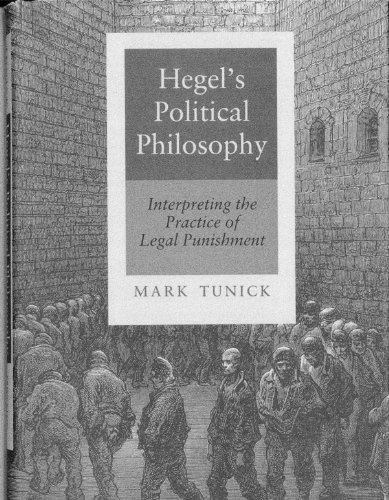
To scholars of Western intellectual history Hegel is one of the most important of all political thinkers, but politicians and other "down-to-earth" persons see his speculative philosophy as far removed from their immediate concerns. Put off by his difficult terminology, many participants in practical politics may also believe that Hegel's idealism unduly legitimates the status quo. By examining his justification of legal punishment, this book introduces a Hegel quite different from these preconceptions: an acute critic of social practices. Mark Tunick draws on recently published but still untranslated lectures of Hegel's philosophy of right to take us to the core of Hegel's political thought. Hegel opposes radical criticism like that later offered by Marx, but, argues Tunick, he employs "immanent" criticism instead. For instance, Hegel claims that punishment is the criminal's right and makes the criminal free. From this standpoint, he defends specific features of the practice of punishment that accord with this retributive ideal and criticizes other features that contradict it. In a lucid account of what Hegel means by right and freedom, Tunick addresses Hegel specialists and those interested in criminal law, the interpretation of legal institutions and social practices, and justification from an immanent standpoint. Originally published in 1992. The Princeton Legacy Library uses the latest print-on-demand technology to again make available previously out-of-print books from the distinguished backlist of Princeton University Press. These editions preserve the original texts of these important books while presenting them in durable paperback and hardcover editions. The goal of the Princeton Legacy Library is to vastly increase access to the rich scholarly heritage found in the thousands of books published by Princeton University Press since its founding in 1905. "This ambitious, highly readable work explores important questions concerning how Hegel's political philosophy is to be taken as well as offering a valuable commentary on Hegel's treatment of specific legal issues." ― Bulletin of the Hegel Society of Great Britain Hegel claims that punishment is the criminal's right and makes the criminal free. In critically examining Hegel's justification of legal punishment, I take us to the core of Hegel's political philosophy, offering an account of what Hegel means by right and freedom. Drawing on lecture notes of Hegel's philosophy of right, which illuminate Hegel's notoriously difficult texts, I reject the commonly taken position that Hegel uncritically accepts existing practices. Acknowledging that Hegel opposes radical criticism of the sort later offered by Marx, I argue that instead Hegel offers another type of criticism-- immanent criticism. Hegel uses the ideal he believes immanent in the practice of legal punishment, retribution, to criticize the actual practice when it diverges from this ideal. I show how Hegel defends specific features of the practice that accord with the retributive ideal, and criticizes other features that contradict it. I discuss Hegel's views on what acts should be made crimes, justified disobedience, criminal accountability, jury trial, sentencing, capital punishment, and plea-bargaining. This is the first book-length treatment in English that shows Hegel applying his ideals to a single concrete social practice. The work is addressed not merely to Hegel specialists, but also to those interested in the criminal law, the interpretation of legal institutions and social practices, and justification from an immanent standpoint. "This lively and engaging book treats Hegel in a lucid, conversational way that has the desirable result of demystifiying his often formidable jargon. Tunick's decision to concentrate on Hegel's theory of punishment will be of interest to Hegel scholars and legal/political theorists. In addition, the work makes good use of the recently published lectures on the Rechtsphilosophie that are not as yet available in English; it will give English-speaking readers who have not consulted these manuscripts a chance to acquaint themselves with some of the critical issues confronted by German Hegel scholars."--Steven B. Smith, Yale University Mark Tunick is Professor of Political Science and Associate Dean at the Wilkes Honors College, Florida Atlantic University, where he teaches courses in political theory, constitutional law, and ethics. Prior to joining the Honors College he taught at Stanford University. He received his Ph.D. at the University of California, Berkeley. Used Book in Good Condition