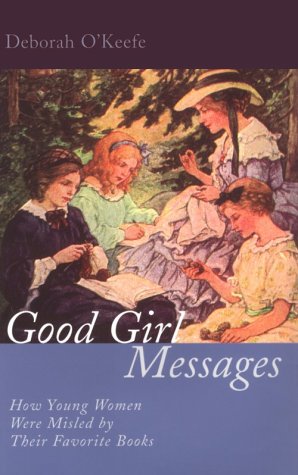
Referencing a range of books, O'Keefe illustrates the typical behavior of fictional girl characters and the impact this has on the self-esteem and self reliance of the young girls who read these books. For much of the twentieth century, books for children encouraged girls to be weak, submissive, and fearful. Good Girl Messages discusses such traits, both blatantly and subtly reinforced, in many of the most popular works of the period. Quoting a wide variety of passages, O'Keefe illustrates the typical behavior of fictional girls-many of whom were passive and immobile while others were actually invalids. They all engaged in approved girlish activities: deferring to elders, observing social constructed proprieties, and accepting conventional suitors. Even feisty tomboys, like Jo in Little Women, eventually gave up their dreams and their independence. Good Girl Messages also includes a discussion of books read by boys, who were depicted as purposeful, daring and dominating. The final chapter reviews, with abundant citations, the enormous changes for the better in children's books over recent decades-stories of girls who do not sell out, who are strong and resourceful as well as loving. Girls in children's books used to be passive, fluttery, saintly, domestic. From Pollyanna to Tarzan's Jane, these characters loved authority; they were always obeying, enduring, sacrificing. O'Keefe believes that many young female readers were damaged by these good-girl stereotypes, though she does quote critics who say that girls identify with Jack the Giant Killer as much as with Sleeping Beauty. For most of the book, O'Keefe analyzes stories she read as a child, all published before 1950, and she admits to being surprised to discover how much things have changed in the last generation. What will interest most readers is her final chapter, crammed with examples of today's strong girl characters: Katherine Paterson's Lyddie, Brock Cole's Celine, Suzanne Fisher Staples' Shabanu, and dozens more. Of course, a lot of the old stuff is still around, and it's interesting to see how far we've come. Be sure to check out the review of Betsy Byars' Me Tarzan (p.1376) in the Books for Youth section for a contemporary view of sex roles in the jungle. Hazel Rochman "The book's great strength is O'Keefe's wide reading: she examines texts from the early nineteenth century through the 1990s." -- Iris, Spring 2001 Deborah O'Keefe is the author of Good Girl Messages: How Young Women Were Misled by Their Favorite Books (Continuum, 2000); Readers in Wonderland: The Liberating Worlds of Fantasy Fiction from Dorothy to Harry Potter (Continuum 2003); and articles in the New York Times and other publications. She has degrees from Smith, Cornell, and Columbia, and has taught at Vassar College and at Manhattanville College. She lives in Chappaqua, New York. Used Book in Good Condition