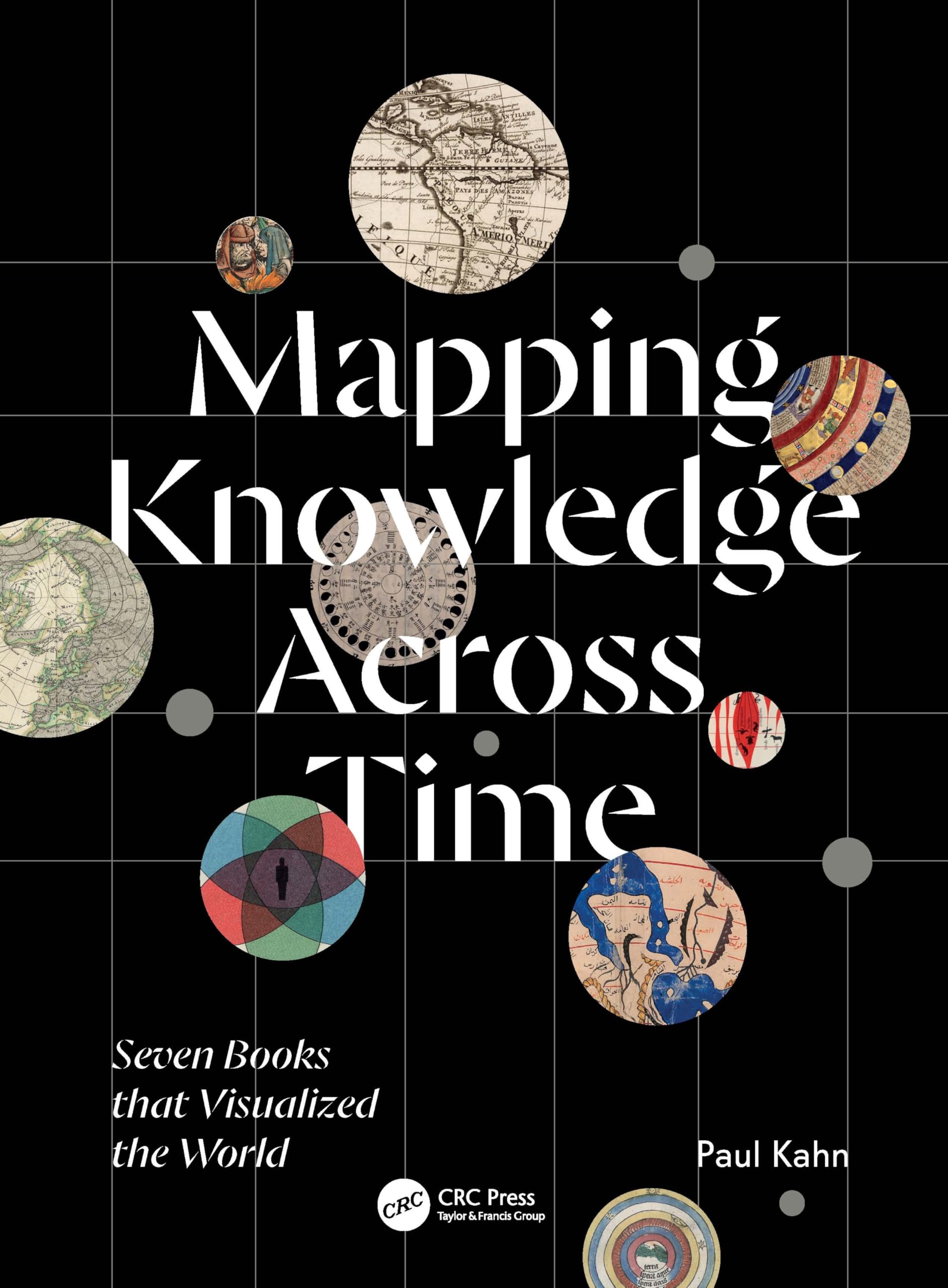
What patterns do we use to represent knowledge of the world? Opening seven books side by side, Mapping Knowledge Across Time asks these difficult questions. What shapes do we use to represent creation? What do we record and what do we ignore when we map the world? How do we create a picture of the past on the page? Where do we locate the future? How do the parts of the world connect? How do these shapes and patterns arranged on book pages compare across eight centuries? What do the visualizations of knowledge from these books help us see today? The result is a tour of the information design patterns from Modernist diagrams of evolution to medieval Islamic maps, from Chinese representations of rivers to Jewish diagrams of astrological cycles. Each chapter flows back and forth between centuries and cultures, interweaving cartography with data visualization, atlases with encyclopedias. Examples unfold from these seven extraordinary book masterpieces, drawn by illuminators, carved into woodblocks, printed from copperplate, cut and pasted onto boards, demonstrating how designers drive a picture of the world into the reader’s mind. The result exposes entire visual systems that continue to inspire designers today. This book will lead you to new ways of seeing connections between the past and the present. You will encounter maps, books, diagrams, data visualization, and global views of our common world that will surprise and inspire the general reader and the specialist. "This masterwork of a history belongs on the shelf of anyone interested in maps, information design more broadly, and how language and representation make the world in which we live. It is a beautiful, richly illustrated, and thoughtful comparison of seven beautiful, richly illustrated, and thoughtful books ― each of which attempted to describe the world of their culture and time. The author, Paul Kahn, may be our preeminent historian of information design. He brings a design practitioner's eye and considerable critical depth and scholarship to this massive undertaking. The book offers a masterclass for both design students and practitioners." -- Hugh Dubberly , Dubberly Design Office "Paul Kahn, wise sage of information design, goes deep into the roots of visual communication with his review of some of the greatest images of data humanity has ever produced. He brings us deep into fantastic books our fast-moving era has sadly forgotten. This book takes us way farther than anywhere you’ll go on the internet." -- David Rothenberg , author of SECRET SOUNDS OF PONDS and THE POSSIBILITY OF REDDISH GREEN "This is a deeply researched, beautifully written journey through eight centuries of information design, showing how seven extraordinary volumes teach us to see books themselves as world-making visual systems. Kahn’s historical matrix of recurring visual strategies makes a case that information design has always been a powerful technology to support the flow of information between people across time." -- Jason Forrest , Chair of Data Visualization & Communication, School of Visual Arts, New York "Paul Kahn tells us the history of information design in an unusual way. By juxtaposing and comparing historical representations of the world that are distant in time, space, and motivation, he uses an iconographic method similar to that of an art historian to show that information design leads creators to use similar forms, ideas and concepts to visualize knowledge regardless of culture. Paul Kahn presents all this in a way that satisfies academic requirements but is also accessible to a wider audience. It is a feast for the eyes and the mind." -- Attila Bátorfy , Master teacher at Eötvös Loránd University, Budapest, and author of Adatvizualizáció (Data Visualization) "Information design lives in context. Mapping Knowledge Across Time goes beyond techniques to explain the motives and circumstances behind design choices. By including the Chinese example Tushubian alongside other cultures, it offers a richer and more complete view of how design purposes and rationales differ across time and societies." -- Liuhuaying Yang , Data visualization specialist and faculty, Complexity Science Hub "Paul Kahn’s Mapping Knowledge Across Time is a fascinating account of sweeping historical breadth. Examining seven canonical books from diverse eras and locales, Kahn highlights the inventive design strategies that each of these volumes used to visualize the world, uncovering surprising similarities across centuries. With his emphasis on these books as unified works of design, Kahn argues that their physical forms, narrative structures, and methods of production are essential to interpreting their graphic visualizations. Richly illustrated and visually stunning, this study offers an original and valuable contribution to the history of information design, book arts, and material culture." -- Benjamin Benus , Professor of Art History, Loyola University New Orleans, and