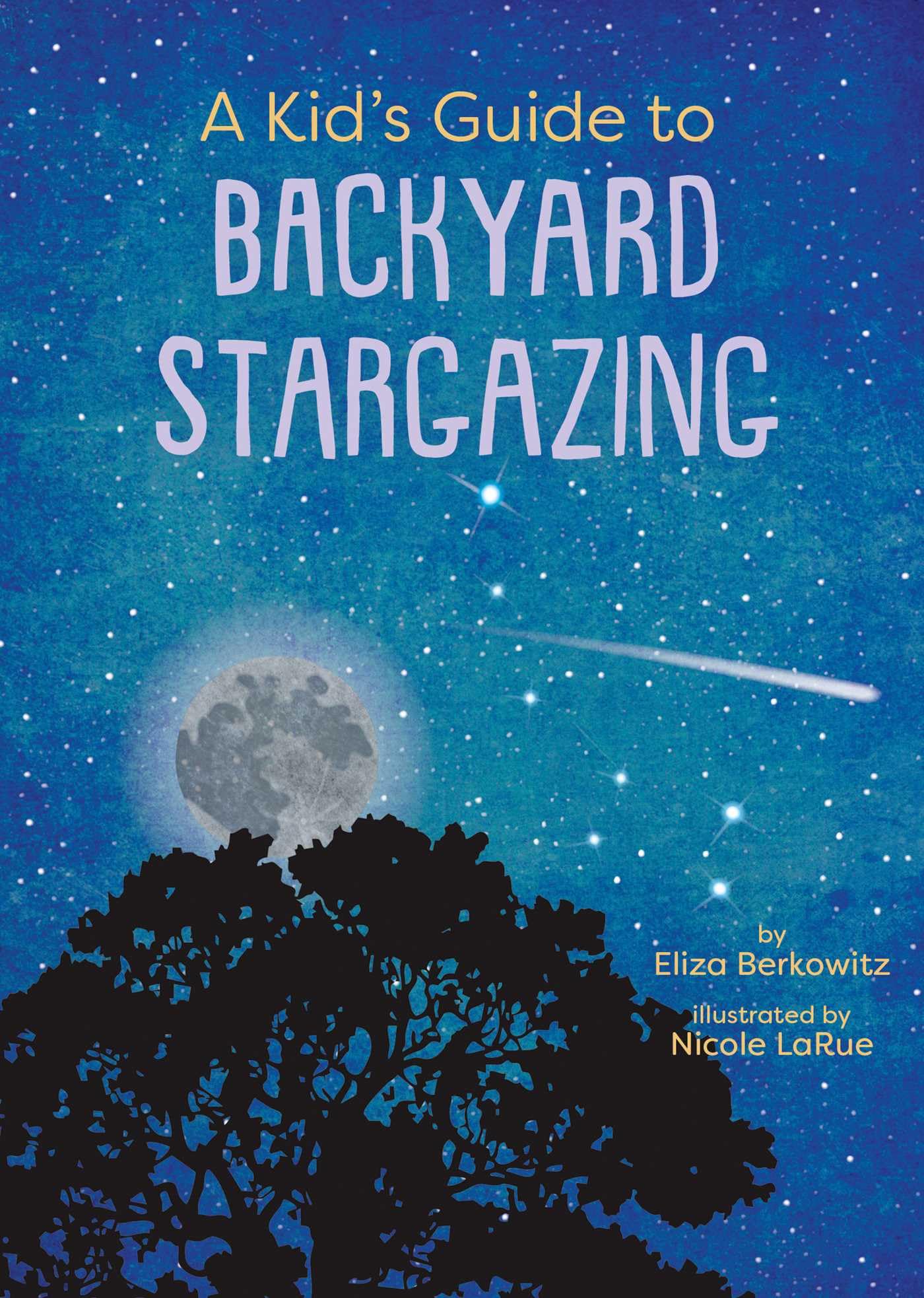
Packed with captivating facts about the Sun, the Moon, the planets, stars, constellations, and other celestial objects—all visible from North America—this brightly illustrated guide is perfect for young nature lovers. “Berkowitz and LaRue immerse readers in the cosmic world of astronomy in this beautifully illustrated and detailed introduction to the hobby.”— School Library Journal A Kid’s Guide to Backyard Stargazing contains easily digestible information and captivating facts—about the most common celestial objects kids see most often—that will help children discover how to be expert nature explorers and why protecting them is important, no matter their age! Learn all about the amazing night sky in A Kid’s Guide to Backyard Stargazing —a handy, easy-to-carry guidebook for explorers ages 6 to 8 that shows you how to identify 28 celestial objects that are commonly visible in the Northern Hemisphere. The book has chapters on the Sun and the Moon (including solar eclipses and lunar eclipses), the planets (including Mercury, Venus, Earth, Mars, Jupiter, Saturn, Uranus, and Neptune), the stars (including the movement of stars, the types of stars, Polaris, Sirius, Arcturus, Vega, Capella, and Rigel), the constellations (including Ursa Major, Cassiopeia, Orion, Canis Major, Centaurus, The Northern Cross, and Ursa Minor), and other celestial objects such as the Milky Way, comets, galaxies, meteoroids, and meteorites. Check the glossary for terms you might not know, keep track of what you’ve seen in a handy log, and try out a fun DIY project for observing the Moon and its phases in a Moon Diary. By learning to recognize stars, constellations, and planets, kids can become a young space explorer—no rocket ship needed! Also available in the series: A Kid’s Guide to Backyard Animals - A Kid’s Guide to Backyard Trees - A Kid’s Guide to Backyard Bugs - A Kid’s Guide to Backyard Birds Berkowitz and LaRue immerse readers in the cosmic world of astronomy in this beautifully illustrated and detailed introduction to the hobby. Starting with what every amateur stargazer needs, including when, where, and how to stargaze, and all the tools required to start, the book quickly transitions into a concise factbook with information on solar and lunar eclipses, all the planets (including whether they're visible from Earth), easily identifiable stars, and seven of the most popular constellations. Young astronomers are encouraged to keep track of their nightly finds in the celestial log at the back of the book. The guidebook's illustrations include detail-rich depictions of how solar and lunar eclipses work, uniquely drawn planets, and colorfully abstract galaxies and auroras. Berkowitz's explanations of scale and distance, the difference between various star types, and bolded astronomy-specific words make for easy understanding and approachable enthusiasm for new star-obsessed readers. VERDICT This title will do well in libraries wanting to expand their self-guided or project-focused factbooks or those looking for family friendly, science-forward activity books. ― School Library Journal Eliza Berkowitz is a writer and editor who has worked on a wide variety of books in her 20-plus years in publishing. In her free time, she loves exploring the natural wonders of Redding, Connecticut, where she lives with her husband, daughter, and dog. Nicole LaRue , a graphic designer and illustrator, believes every person—no matter their size, age, color, or status—can help create positive social change. Called upon at the eleventh hour to create the official logo for the 2017 Women’s March on Washington, she is no stranger to mighty work. Her clients include Chronicle Books, Abram’s Books, Oxford University Press, Compendium Inc., Madison Park Greetings, Johnson & Johnson, Chat Books, Tiny Prints, DC Shoes, American Eagle, and more. See her work at www.smallmadegoods.com. Nicole resides in Salt Lake City, Utah.