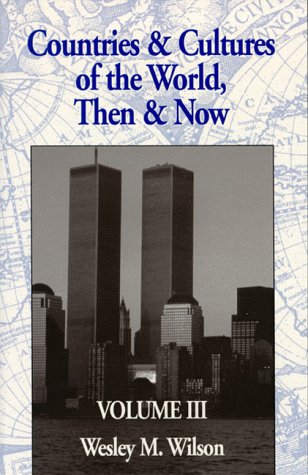
In this volume the author takes us to every country in South America and Central America. The author discusses why the Catholic Church, dictators, and the military have played such an important role and how the native Amerindians have often maintained their separate cultures in many countries. We go with the author to Inca ruins in Cuzco and Macchu Picchu, on boats on the Amazon and other rivers, to isolated jungle villages, to a ranch in Argentina, to a desert where it never rains, to the cold Andes, and to graceful dances in Latin America' cities. One of the author's visits to Chile was in 1970, shortly before the elction of socialist Allende. Later, the author visited the war zone of Nicaragua in 1987 when Contras regularly attacked. Then, the author takes us to Cuba where he had a chance to talk with many people. We learn how socialism has helped and hurt Cuba. We learn the background of the blockade by the USA and what will probably happen if it is lifted. Mexico, the important neighbor adjoining the U.S.A., represents all of Latin America--its problems, great poverty and wealth, corruption, an uncertain future, and great tourist sites. Finally, the author takes us to our Canada. Canadians are in many ways similar to people in the U.S.A., yet they are are proud of their differences. The author studied four summers in French-speaking universities in Quebec, while living with local families. He and his wife have also driven the Alcan Highway, and the Trans-Canada Highway from Newfoundland through Vancouver Island. They have hiked in much of the Yukon. The author looks at the future of Quebec and Canada. This volume also describes travels in all 50 states of the U.S.A., from the point of view of a world traveler. The author describes visits to nearly all national parks, from Florida to Alaska, and California to Maine. After a capsule history of the U.S.A. in 10 pages he compares the economy and culture of the U.S.A. with that of Europe. He made a bicycle camping trip across the Southwest, and he has hiked much of the Pacific Crest Trail. The author describes many anecdotes with a sense of humor. Don't be deterred by the academic-sounding title of these three volumes. The books are quite readable. Reading them will inform you what it is really like in many countries, almost as effectively as going there. They are based upon daily travel journals that I wrote in more than 120 countries. Other travelers, noticing that I recorded everything of importance, said you should write a book. I re-read those notes and also examined several file cabinets full of tourist brochures, booklets, and maps, and several bookcases filled with books in five languages that I acquired abroad. Even after I eliminated boring details, the book fills three volumes. The books will broaden the horizons of the reader. They can be read only a few minutes a day, or all at once. I have tried to present much information while also making it readable and interesting. Little anecdotes and humor brighten the text. The books will be a good reference source, a literal "encyclopedia of our world." Readers who like the books the best are those who have traveled everywhere. They say the books refresh their memory about each place, and they learned a lot more about each country they had visited. Armchair travelers and history buffs also like the books. These books will give you facts and insights to help answer these questions and more: --Why are some socialist countries wavering between socialism and a free market economy? --Will all Islamic countries have a fundamentalist government in a few years, or is that trend ending? --Why are there so many civil wars, especially in Africa? --Should the U.S.A. and the U.N. support independence movements by groups of people or tribes everywhere? --Should Quebec stay in Canada? What will happen if it secedes? --What is the future of Israel and the Palestinians? --Will the population in Africa, Asia, and Latin America continue to shoot upward? Will there be mass starvation in many places? --Will the poor of the world continue to move in great numbers, legally or illegally, into the rich countries--the U.S.A., Western Europe, and Australia? --Will nearly all manufacturing in the world be done in eastern and southern Asia in 20 years? --How does the economy of the U.S.A. compare with countries in Western Europe, Japan, and Russia? --Where are the countries of the former Soviet Union heading? --Will the TV programs, movies, popular music, short order restaurants, and the rest of the culture of the U.S.A. overwhelm the other cultures? --Will everyone be speaking English in 20 years or so? We must know something about the CULTURE of the people. Our planet is complex, we do not share the same outlook. We don't have the same goals. We should avoid judging others by our standards. I have tried to write "facts" about a country and the world as people in that country view those "facts," or objectively,