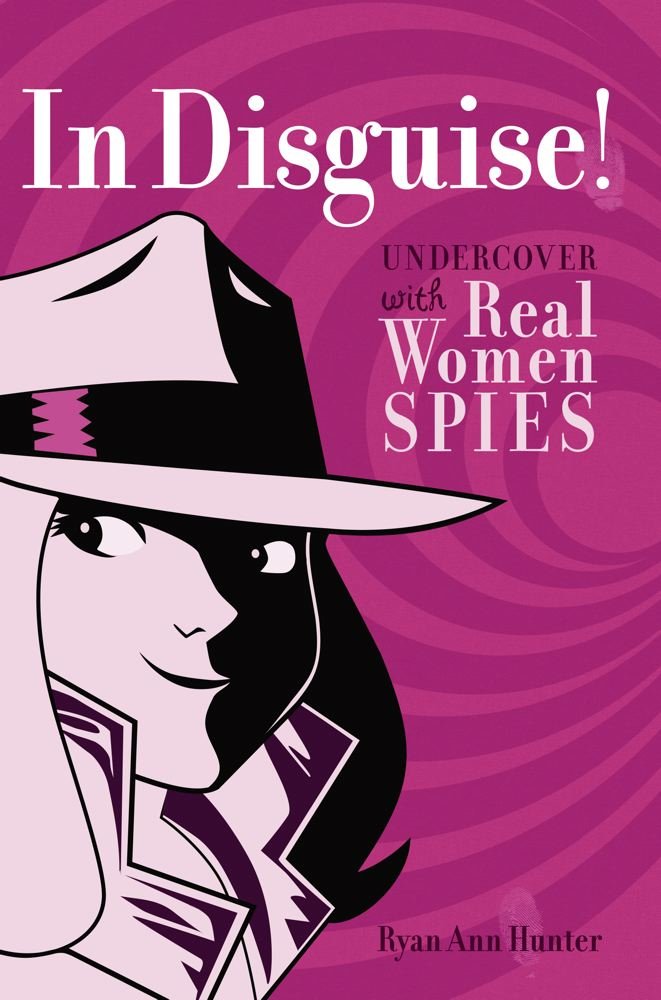
Investigate real-life adventures of espionage in this collection of impressive and inspiring profiles. Spanning more than 300 years and numerous countries, In Disguise! details the lives of some of history’s most daring women, all of whom risked their lives to stand up for their beliefs. Originally published a decade ago, this fully updated and expanded edition of In Disguise! profiles twenty-eight daring international secret agents, from Harriet Tubman, who freed hundreds of slaves during the Civil War, to Eva Wu, who hid secret messages in her hair to aid the Chinese Revolution, to the modern-day exploits of former CIA agent Valerie Plame. With riveting narratives, fun quizzes to determine if you have what it takes to go undercover, secret-agent trivia, and short spotlight bios, In Disguise! is sure to engage and inspire. Gr 7-10-This collection, updated from a 2003 edition, features spies from the 17th century through the modern era. Some stories are noteworthy, including Pauline Cushman's transition from actress to spy and Sarah Emma Edmonds's disguised persona as a man during the Civil War. Others, like Harriet Tubman's brave work on the Underground Railroad, are less compelling. Each entry starts with a short teaser that builds interest while serving as a helpful prereading tool. Several shorter "spotlights" feature brief profiles, events, and inventions while "spycraft" gives instructions for making invisible ink and tips for changing one's appearance. The layout is somewhat claustrophobic with little white space, and while sidebars help break up the text, many of them are unrelated to the content on the page. Visuals include appropriate historical maps and drawings based on photographs or typical styles of the era. There is no index, which might make this book difficult for research. It complements other true-spy accounts, such as Paul Janeczko's The Dark Game: True Spy Stories from Invisible Ink to CIA Moles (Candlewick, 2010) and Penny Colman's Spies! Women in the Civil War (Shoe Tree, 1992) and will appeal to those particularly interested in learning more about espionage.-Carrie Shaurette, Dwight-Englewood School, NJα(c) Copyright 2013. Library Journals LLC, a wholly owned subsidiary of Media Source, Inc. No redistribution permitted. In this revised edition of a 2003 book, Hunter supplies two- to three-page profiles of 28 women spies from around the world. Arranged in chronological order, the book begins with the Anglo-Dutch Wars (1652–74) and ends with a modern-day American spy. Most are lesser known, though the lineup does include Harriet Tubman and Josephine Baker. Each chapter begins with an overview of a conflict and a map of where the action takes place, followed by the profiles of spies associated with the event. (Profile illustrations were not available for review.) The book includes brief spotlights of other spies, as well as numerous spy facts in text boxes. Distributed throughout are spycraft hints for future spies. The dangerous activities of the women are realistically presented, albeit in a fairly bland narrative style. Includes detailed chapter notes, an extensive bibliography on each spy, and books of spy files. Grades 5-8. --J. B. Petty Ryan Ann Hunter is a pen name for Pamela D. Greenwood and Elizabeth G. Macalaster, who have teamed up to write books about bridges, tunnels, skyscrapers, airplanes, robots, the history of flight, and women spies. Their books have garnered several awards, including the Children’s Book Sense Pick, the Chicago Public Library Best of the Best, Parenting magazine Book of the Year award, Oppenheim Toy Portfolio Gold Best Book award, and Austin Young Engineer’s Award. A native of North Carolina, Jeanette Little is an artist and illustrator living and working in Portland, Oregon. She received her BFA in painting from East Carolina University and then studied in the University of Oregon's MFA painting program. Her work has appeared in several publications as well as on national television. She has exhibited across the United States and has pieces in private collections from New York to Los Angeles. The American Revolution (1775–1783) For years, the desire for freedom from Britain grew among the colonists in North America. Fighting began in Massachusetts in 1775, and finally, on July 4, 1776, thirteen colonies adopted the Declaration of Independence, proclaiming themselves part of a new country. The Patriots joined the Continental Army, led by General George Washington. These included settlers homesteading in wilderness areas north and west of the thirteen original colonies. Other colonists, the Tories, remained loyal to the British. At first, it seemed the British would win the war. They captured New York and Philadelphia. The war spread to the Southern colonies. The Continental Army was not well supplied, and during the harsh winters, many soldiers got sick and died, and others deserted. General Washington sought the support of oth