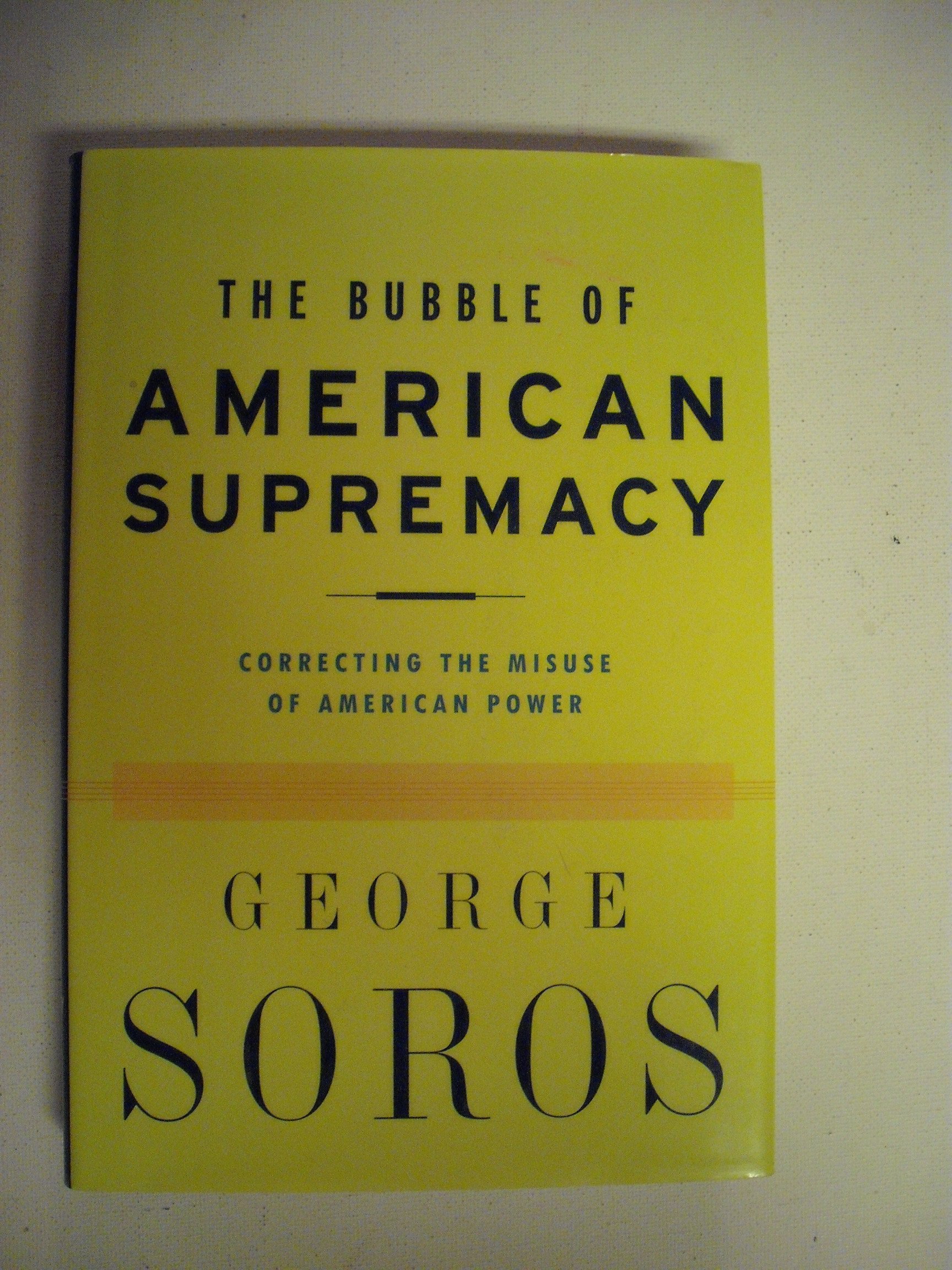
Long known as "the world's only private citizen with a foreign policy," George Soros combines his razor-sharp sense of economic trends with his passionate advocacy for open societies and decency in world politics to come up with a workable, and severely critical, analysis of the Bush administration's overreaching, militaristic foreign policy. Soros believes that this administration's plans abroad come from the same sort of "bubble" psychology that afflicted our markets in the late 1990s. They have used a real fact, our overwhelming military supremacy, to create a deluded worldview, that might makes right and that "you're either with us or against us," in the same way that the recent boom used a real fact, the growth in technology, to lead to a delusion, the "new economy." Like the best of the books that have responded quickly to world events, The Bubble of American Supremacy has a clear, intriguing, comprehensive thesis that makes necessary, and compelling, order of our seemingly disordered world. Proving that exorbitant wealth and allegiance to the Republican Party do not necessarily go hand in hand, billionaire George Soros offers a sharp critique of the neoconservative philosophy that he sees guiding the George W. Bush administration. In The Bubble of American Supremacy , Soros warns that American efforts to be the ultimate global superpower will not only be unsuccessful but will make America and the world infinitely more unstable. Bush and company, he says, have callously used the events of September 11th for their own political gain and misled the world about the threat posed by Iraq. In previous American presidential elections, billionaires Steve Forbes and Ross Perot have tried to run for president themselves to address the country's problems, but Soros--while no less zealous about his convictions--sees his role a little differently. "I have made it my primary objective to persuade the American public to reject President Bush in the upcoming elections," he writes, "We have been deceived." The arguments he makes and the evidence he presents are interesting enough, although there really isn't anything here that hasn't been written in scores of other anti-Bush books released around the same time. What sets Soros's book apart from all the others is the recurring presence of Soros himself, frequently citing previous books he's written, speeches he's made, and highlights of his career. The pronoun "I" is never far away. Granted, it's been an interesting career; his financial success coupled with his passionate political convictions would make for a terrific memoir, but at times in this book Soros's ego gets almost comically in the way. Referring to his long-held support for open societies, he says this philosophy "could almost be called the Soros doctrine" only to renounce propriety over it a page later. Soros is a capable writer and a clear thinker, and he ably articulates his views. Readers interested in criticisms of Bush and company have several options but readers interested in George Soros will find plenty to satisfy them here. --John Moe The stream of anti-Bush books has turned into a torrent. But where Alterman and Green's offering covers familiar territory in great detail, Soros' contribution is almost stunning in its simplicity. Alterman, the author of What Liberal Media? [BKL F 1 03], and Green, a New York City Democrat, offer a critique of both the president and his policies, with one of their main premises being that Bush starts with conclusions and then finds facts with which to frame them. So how does he make decisions? According to the authors, by asking what the religious right wants, what big business wants, and what the neocons want, and then proceeding accordingly. Chapters on the environment, business fraud, civil liberties, race, education, and, of course, foreign policy offer myriad examples of the authors' theories on how Bush misleads. It's all presented in highly readable fashion, but with the awakening economy and the passage of the Medicare bill, some of the information will seem out date. Those familiar with the anti-Bush canon will find this entry closest to David Corn's Lies of George W. Bush [BKL O 1 03], but Alterman has a higher profile and will make a bigger splash on the news shows. Soros, who has made headlines for donating millions of dollars to stop the reelection of George Bush, is a man who puts his money where his mouth is. With the publication of this book, he may find that his words are also a potent weapon for realizing his goal. The founder of a fund-management group, Soros uses the metaphor of the economic bubble to show that the Bush administration's foreign policy is based on assumptions that are not only incorrect and deceptive but also will eventually burst. Step-by-step, he exposes a foreign policy that he believes contradicts American principles and has no hope of obtaining its goals of supremacy. He pulls no punches: "I contend that the Bus