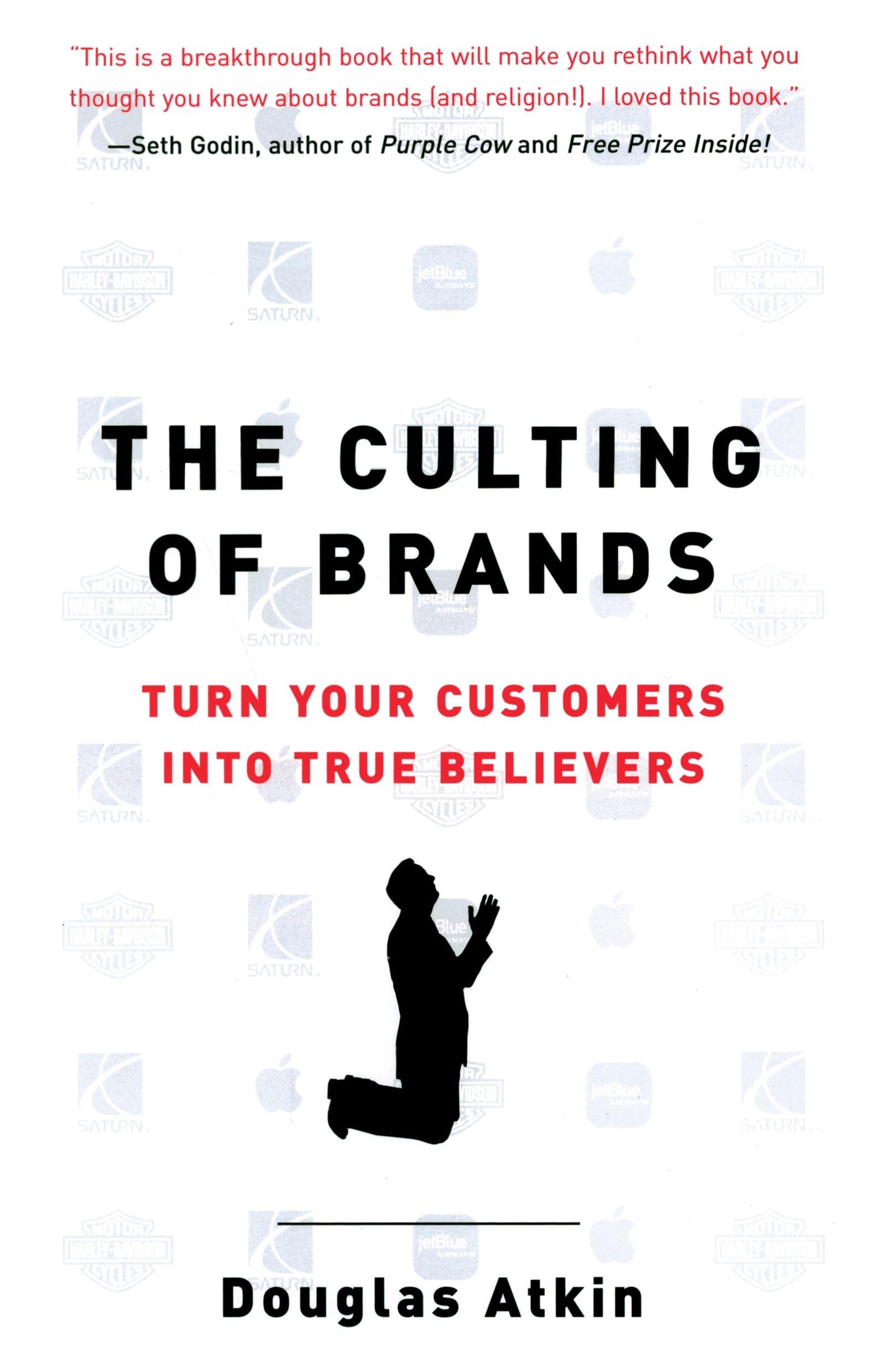
At first glance, companies like Apple and Nike have little in common with organizations like the Hell’s Angels and the Unification Church. But in reality, they all fulfill the main definition of a cult: They attract people who see themselves as different from the masses in some fundamental way. Contrary to stereotypes, most cult members aren’t emotionally unstable—they’re just normal folks searching for a sense of belonging. Marketing expert Douglas Atkin has spent years researching both full-blown cults and companies that use cult-branding techniques.He interviewed countless cult members to find out what makes them tick. And he explains exactly how brands like Harley-Davidson, Saturn, JetBlue, and Ben & Jerry’s make their customers feel unique, important, and part of an exclusive group—and how that leads to solid, long-term relationships between a company and its customers. In addition to describing a fascinating phenomenon, The Culting of Brands will be of enormous value to business leaders. It will teach marketers how to align themselves with a specific segment of the population, how to attract and keep new "members," how to establish a mythology about the company, and how to manage a workforce filled with true believers. Once a brand achieves cult status, it becomes almost impossible for a competitor to dethrone it. The Culting of Brands will reveal the secrets of fierce customer identification and, most important, unbreakable loyalty. Douglas Atkin is the director of strategy at one of New York’s hottest advertising agencies, Merkley Newman Harty. He has worked with numerous clients to increase their cult appeal, including Mercedes, Pfizer, Smith Barney, Fila, and JetBlue. This is his first book. INTRODUCTION That there was a possible connection between cults and brands became more and more apparent to me as I watched people at a research facility on a cold night in New York. Eight customers had been asked to share their feelings about a well-known brand of sneaker. These eight individuals expressed the kind of intense conviction I had only imagined possible at a revivalist meeting or cult gathering. Their language verged on evangelical; their passion was on the brink of zealotry. They were converts. What I was watching was ironic considering that I had just come from a meeting of anxious marketers who had been fretting that brand loyalty was dead. There were too many products, and they were too much the same. The consumer was king and marketers were servants reduced to begging for a scrap of attention to be paid to their brand before customers moved on to the next. These handwringers clearly hadn't met the consumers I was watching in that research room. Where did that kind of cultlike devotion come from? How can anyone venerate something as banal as footwear? Can that kind of commitment be reproduced for other brands? Perhaps, I wondered, the answers to these questions could be found by studying the ultimate expression of devotion, the kind that is found in cults. If these people had cultlike devotion, then why not look at the original, cult devotion? How do cults generate such famously intense attachment? How do the few cult brands that exist create strong commitment? Are the dynamics of attraction essentially the same? And if so, are the techniques that create that degree of devotion transferable between the two? I resolved that night to try and answer these questions by researching organizations that appeared to breed cultlike attraction, whether they existed in the sacred or secular realms. In the years that followed I met members of cults both famous and furtive; I met CEOs of companies and the brand addicts they had nurtured; I met with soldiers, Trekkies, fans, and cult deprogrammers. A Mac user told me that “PC users must be saved” and a young cult member insisted that his religion is a “brand.” ISN'T THIS EXERCISE FAR-FETCHED, EVEN UNETHICAL? Aren't cults manipulative, evil organizations intent on exploiting the gullible? Should they be a source of insight for commercial gain? In any case perhaps the insights are not transferable. And isn't it a little implausible to believe that anyone, at least on a large scale, will attach themselves to a brand with the same devotion as a religion? Surely the sacred and the profane should, and really do occupy separate worlds. Let's look at the last point first. The worlds of the sacred and profane are coming closer together whether we like it or not. And much of this initiative is being taken by religious organizations. So-called Mega-churches (there are over seven hundred in America today with three million members), are building shopping malls so the unbaptised can browse their religion after browsing the clothing rack, or fitness clubs so they can have a spiritual workout after their physical one.1 Some of the flourishing evangelical churches employ classic marketing programs to attract new “customers” using advertising, mailshots, and e-mail