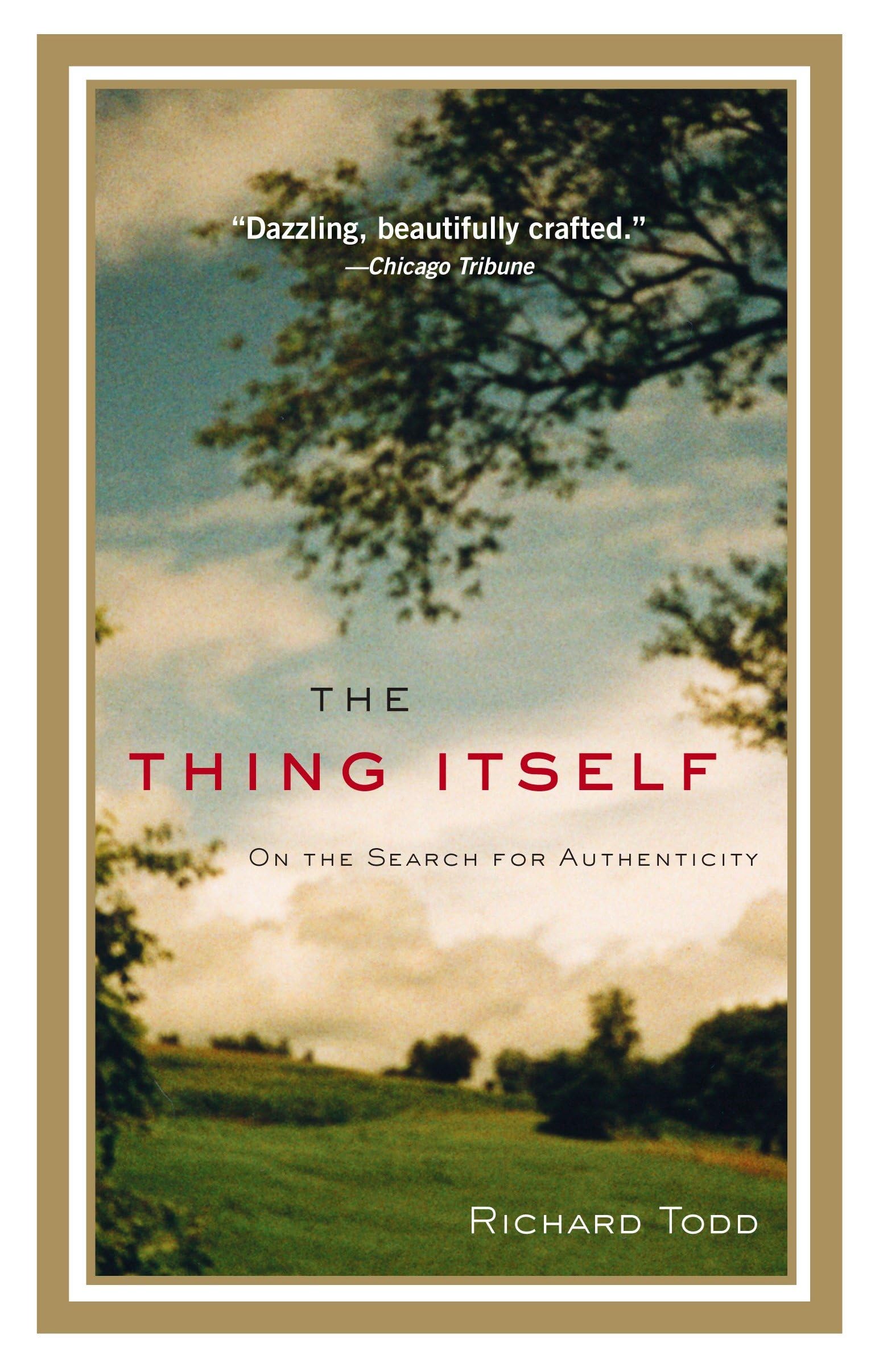
The celebrated literary memoir and chronicle of one man's search for the elusive gift of authenticity. Troubled by the lack of substance in contemporary life, Richard Todd suspects that much of what we experience is false. In this unique pursuit of the "genuine," Todd examines his search for authenticity in places and objects, in politics and ideas, and in ourselves, and recounts his efforts to understand the desire to be a real person in a real world. "There is a sweet memoir embedded in this book of cultural criticism, into which Mr. Todd has deftly wrangled the whole gang, from Jean Baudrillard to Lionel Trilling." -"The New York Times" "An arch and eloquent meditation." -"O, " the Oprah magazine "Dazzling, beautifully crafted...A small masterpiece- and 'small' only because of its brevity, not its scope." -"Chicago Tribune" "Provocative and oddly comforting...Refreshing." -"The Arizona Republic" "A fully realized, brave, and movingly honest memoir...[Todd] makes a figure in which to contemplate ourselves." -"Ploughshares" "A splendid book, brimming with wit and original insights...Most pertinent to the way we live now." -Ward Just, author of "Forgetfulness" aThere is a sweet memoir embedded in this book of cultural criticism, into which Mr. Todd has deftly wrangled the whole gang, from Jean Baudrillard to Lionel Trilling.a a"The New York Times" aAn arch and eloquent meditation.a a"O," the Oprah magazine aDazzling, beautifully crafted...A small masterpiecea and asmalla only because of its brevity, not its scope.a a"Chicago Tribune" aProvocative and oddly comfortinga]Refreshing.a a"The Arizona Republic" aA fully realized, brave, and movingly honest memoira][Todd] makes a figure in which to contemplate ourselves.a a"Ploughshares" aA splendid book, brimming with wit and original insightsa]Most pertinent to the way we live now.a aWard Just, author of "Forgetfulness" Richard Todd has spent many years as a magazine and book editor at The Atlantic, New England Monthly, and Houghton Mifflin. His essays and cultural reportage have appeared in The Atlantic, Harper’s, The New York Times, Worth, and numerous other magazines. A member of the MFA faculty at Goucher College, he lives in Western Massachusetts. From The Washington Post's Book World/washingtonpost.com Reviewed by Nora Krug "Of course my life is real," Richard Todd begins in "The Thing Itself," "and so is yours." But, he continues, "things start to add up . . . that conspire to make me think there is a scrim between me and the world, that something more substantial, more essential, lies behind or below or beyond the apparitions before us." Finding that elusive reality -- the thing itself -- is the heart of Todd's provocative meditation on contemporary life. Oddly, in his search for authenticity, Todd seeks it out in places he's least likely to find it: Disney World, Las Vegas, suburbia. Yet his observations, grounded in the work of philosophers and cultural observers from Thoreau and Trilling to Michael Pollan and David Brooks, add up to an intriguing combination of snobbishness and empathy: "In the vacant eyes of that girl outside the Cinemark," he writes, "lurks a more sophisticated way of seeing the mall than in mine. . . . It may even make her happy." Todd has a tendency to overanalyze: "Is the guy who wears Tommy on his back participating in a clever, knowing, postmodern joke, whose unspoken text is that we all secretly care about labels, so why not acknowledge that in big campy letters?" Sometimes a logo is just a logo. But his eloquence, intelligence and self-effacing manner -- one might even call it authenticity -- more than make up for any affectations. At 34, Meredith Norton was a semi-happy expatriate, an African American mom living with her French husband and their infant son in Paris. Her medical concerns, she writes, were mostly "small issues I overreacted to, like when my nose started whistling." But during a visit to her Bay Area home, one of those small issues -- "my comically askew breasts" -- became a real problem. After a diagnosis of inflammatory breast cancer, Norton was given a 40 percent chance of surviving five years. She met the news with the bittersweet humor that permeates her book: "Two strangers had just witnessed the most intimate moment of my life. It was worse than being walked in on while losing your virginity or giving birth in front of a stadium of people." In the burgeoning genre of the cancer memoir, Norton's contribution is exceptional. As she chronicles the harrowing details of her treatment, Norton is witty and bracingly unsentimental. Two years after her diagnosis, she emerges with a clean bill of health but few words of wisdom: "We were just as mediocre as when this whole drama began," she writes of herself and her husband, "even more so, because we'd paid the price for enlightenment." Also of Interest An anorexic eel, a surly chimp with a penchant for headstands and a goldf