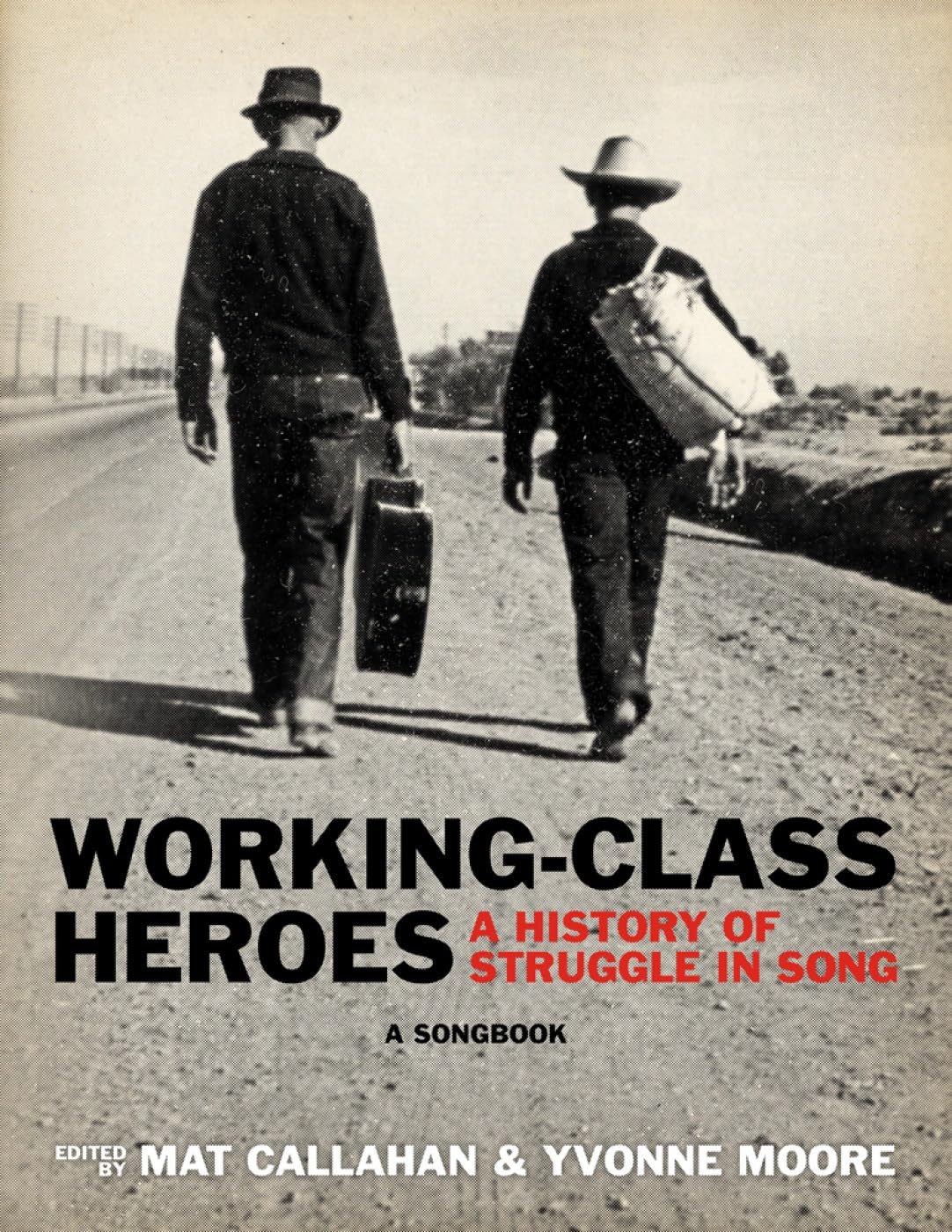
Working-Class Heroes is an organic melding of history, music, and politics that demonstrates with remarkably colorful evidence that workers everywhere will struggle to improve their conditions of life. And among them will be workers who share an insight: in order to better our lot, we must act collectively to change the world. This profusely illustrated treasury of song sheets, lyrics, photographs, histories, and biographical sketches explores the notion that our best hope lies in the capacity of ordinary working people to awaken to the need to emancipate ourselves and all of humanity. Featuring over a dozen songwriters, from Joe Hill to Aunt Molly Jackson, Working-Class Heroes delivers a lyrical death blow to the falsehood that so-called political songs of the twentieth century were all written by intellectuals in New York. Many, like Ella May Wiggins, were murdered by the bosses. Others, like Sarah Ogan Gunning, watched their children starve to death and their husbands die of black lung, only to rise up singing against the system that caused so much misery. Most of the songs collected here are from the early twentieth century, yet their striking relevance to current affairs invites us to explore the historical conditions that inspired their creation: systemic crisis, advancing fascism, and the threat of world war. In the face of violent terror, these working-class songwriters bravely stood up to fight oppression. Such courage is immortal, and the songs of such heroes can still lift our spirits, if we sing them today. Featured in this twenty-song collection are Sarah Ogan Gunning, Ralph Chaplin, Woody Guthrie, Ella May Wiggins, Joe Hill, Paul Robeson, John Handcox, Aunt Molly Jackson, Jim Garland, Alfred Hayes, Joseph Brandon, and several anonymous proletarian songwriters whose names have been long forgotten, though their words will never die. “This is one of the most captivating, intimate, no-holds-barred books of working-class history I have ever read. And it’s a songbook, too!” —David Rovics “The world needs more thinkers like Mat Callahan.” —Jared Soper, SLUG magazine Mat Callahan is a musician and author originally from San Francisco. Recent projects include the republication of Songs of Freedom by Irish revolutionary James Connolly, the recording and publication of Working-Class Heroes, and the launch of the multimedia project Songs of Slavery and Emancipation. He is the author of five books including, in 2017, The Explosion of Deferred Dreams (PM Press) and A Critical Guide to Intellectual Property (Zed Books). Callahan can be reached at www.matcallahan.com. Yvonne Moore is a singer and bandleader originally from Schaffhausen. In addition to recording numerous albums of her own music, Moore is cofounder and treasurer of the Art in History and Politics Association, whose purpose is to discover, publish, and popularize music, graphic art, and texts created by participants in conflicts such as the struggle to abolish slavery. Her exploration of the songs of Sarah Ogan Gunning led to the making of Working-Class Heroes . Moore can be reached at www.matandyvonne.com. Working-Class Heroes A History of Struggle in Song By Mat Callahan, Yvonne Moore PM Press Copyright © 2019 PM Press All rights reserved. ISBN: 978-1-62963-702-0 Contents Introduction, There Is Mean Things Happening In This Land, Singers, Songs, and Heroes: Biographical Sketches, Notes on the Songs, Words and Music, Come All You Coal Miners, There Is Mean Things Happening In This Land, I Am A Girl Of Constant Sorrow, Come On Friends And Let's Go Down, I Am A Union Woman, I Hate The Capitalist System, Mama Don't 'Low No Bush-Wahs Hangin' Around, Dreadful Memories, The Murder Of Harry Simms, The Mill Mother's Song, Toiling On Life's Pilgrim Pathway, Rock-A-Bye Baby, Going Down The Road Feelin' Bad, Skinnamalinkadoolium, A Fool There Was, The Preacher And The Slave, Joe Hill, We Have Fed You All For A Thousand Years, No More Mournin', The Commonwealth Of Toil, Sources, Appendix: Music and Historical Memory, Acknowledgments, About the Editors, CHAPTER 1 There Is Mean Things Happening In This Land The songs we chose have specific characteristics that make them particularly timely today, as is illustrated by John Handcox's "There Is Mean Things Happening In This Land." But this goes beyond their lyrics or melodies to the facts of their origin and the purposes to which they were originally put. These origins and purposes make these songs more than mere relics of a bygone era or curiosities of an "old, weird America." As songs and as evidence, they challenge many widely accepted notions concerning music, history, and politics. For example, it might at first appear that these songs are anomalies or that Hard Hitting Songs is merely the product of Lomax's, Guthrie's, and Seeger's ideological bias. In fact, there is an inexhaustible supply of such songs. We chose these not bec