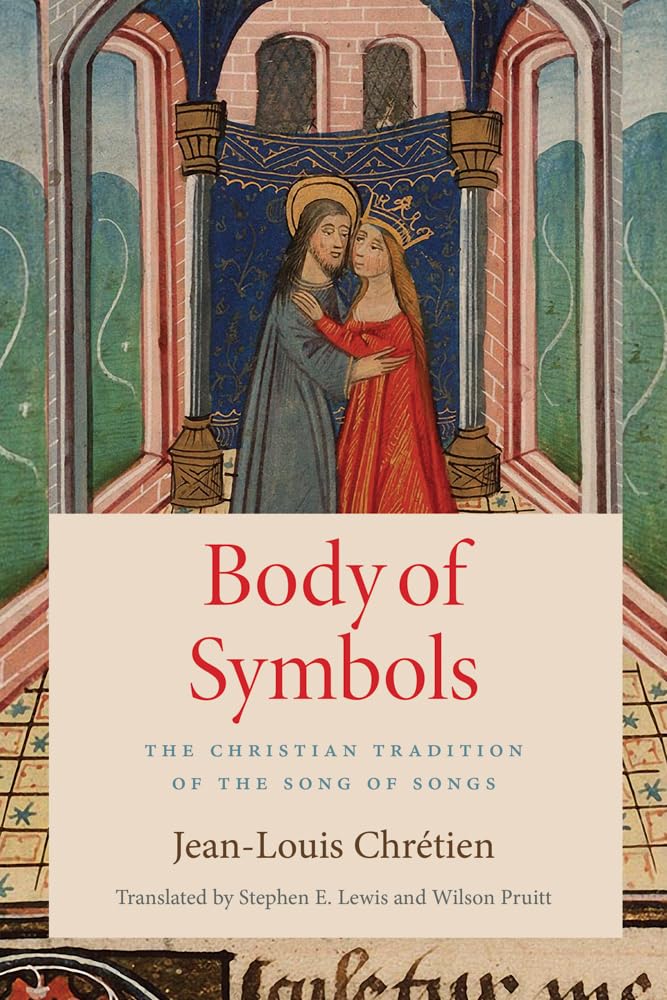
The Song of Songs is a song of love; it is also a song of the body, masculine and feminine, that praises its members, one by one. Over time, the vigilance of its Christian readers drew from the Song a powerful and differentiated logic and symbolism of the body. This book studies the meaning and constitution of this symbolic logic, from the origins to the thirteenth century, across thirty or so authors (notably Origen, St. Augustine, and St. Bernard), as well as its posterity among certain modern authors (like Luther, St. Francis de Sales, or Paul Claudel). The body’s meaning is pondered here in the diversity of its gestures and its members―the eyes, the nose, hair, the lips, the arms and legs, the breasts, and more. This symbolic logic of the organs is twofold: it is applied to the collective body of the community as well as to the powers of the inner man. Essential dimensions of Christian thinking about the body, largely unrecognized, are thus explored. They have influenced our language and our relation to the world in many ways. What are the powers of our body’s members, and how far does the light of the body shine? What does it show? What does it mean to belong to a community? The strength of the Song of Songs’ words gives us endless food for thought about these questions. "In Body of Symbols, we find Jean-Louis Chrétien at the height of his powers. This book reminds us that there is a theory of the body already in the Bible, and another, developed substantially on that basis, found in the works of the Fathers (Augustine, Origen) and their line, a spiritual tradition running from Bernard through Claudel. It also demonstrates the contributions of the phenomenological method unavailable to those earlier thinkers, and thus furthers the growth of the phenomenological tradition. Chrétien does not propose to depart from what is learned from the Song of Songs, and still less to correct it. Rather, the fifteen chapters of this work attempt to deepen it, and perhaps to enrich our sense of its continued pertinence for religion and for the world in which it is lived. Lewis and Pruitt have produced a fine translation, bringing us close to the author’s poetic French without stumbling over false constructions or stray Gallicisms. The reader learns much about the rich symbolism of an ancient text, the skill and tenacity of its best interpreters, and the importance of opening philosophy to its claims."―Jeffrey Bloechl, Albert J. Fitzgibbons Professor of Philosophy, Boston College "Undeniably challenging with its intricate turns of thought and phrasing, its sensuous diction, and its vast archive of Scriptural, theological, and philosophical references and allusions, Chrétien’s 2005 magnum opus is here rendered in accurate and graceful English that fully matches the probity and elegance of the French original."―Thomas Pfau, Alice Mary Baldwin Professor of English & Professor of Historical Theology, Duke University "Jean-Louis Chrétien was a phenomenological philosopher of the first rank, a poet, and a writer of lucid and elegant prose, which this translation renders into equally lovely English. Here he provides a detailed depiction of the meaning of our bodies by way of engagement with the Song of Songs, and in doing that he shows what it is to look closely at our bodies as how we image God and as how, therefore, we respond to every call made upon us. This is Christian theology of the highest order."―Paul J. Griffiths "Perhaps the most brilliant book by surely the most subtle theological mind of recent times. For Chrétien, the strange incarnational doctrine of the spiritual senses lies at the core of Christian spiritual and ecclesial practice: our human spirit is metaphorically sensitive, but our corporeal senses are secretly apprehensive of the supernatural. An exacting and delicately wrought translation by Stephen E. Lewis and Wilson Pruitt."―Catherine Pickstock, Norris-Hulse Professor of Divinity, University of Cambridge Jean-Louis Chrétien (1952 - 2019) was a French Catholic phenomenologist and Sorbonne professor of philosophy. He is the author of thirty or so works of philosophy, theology, and poetry, published between 1985 and 2017, six of which have been published in English translation.